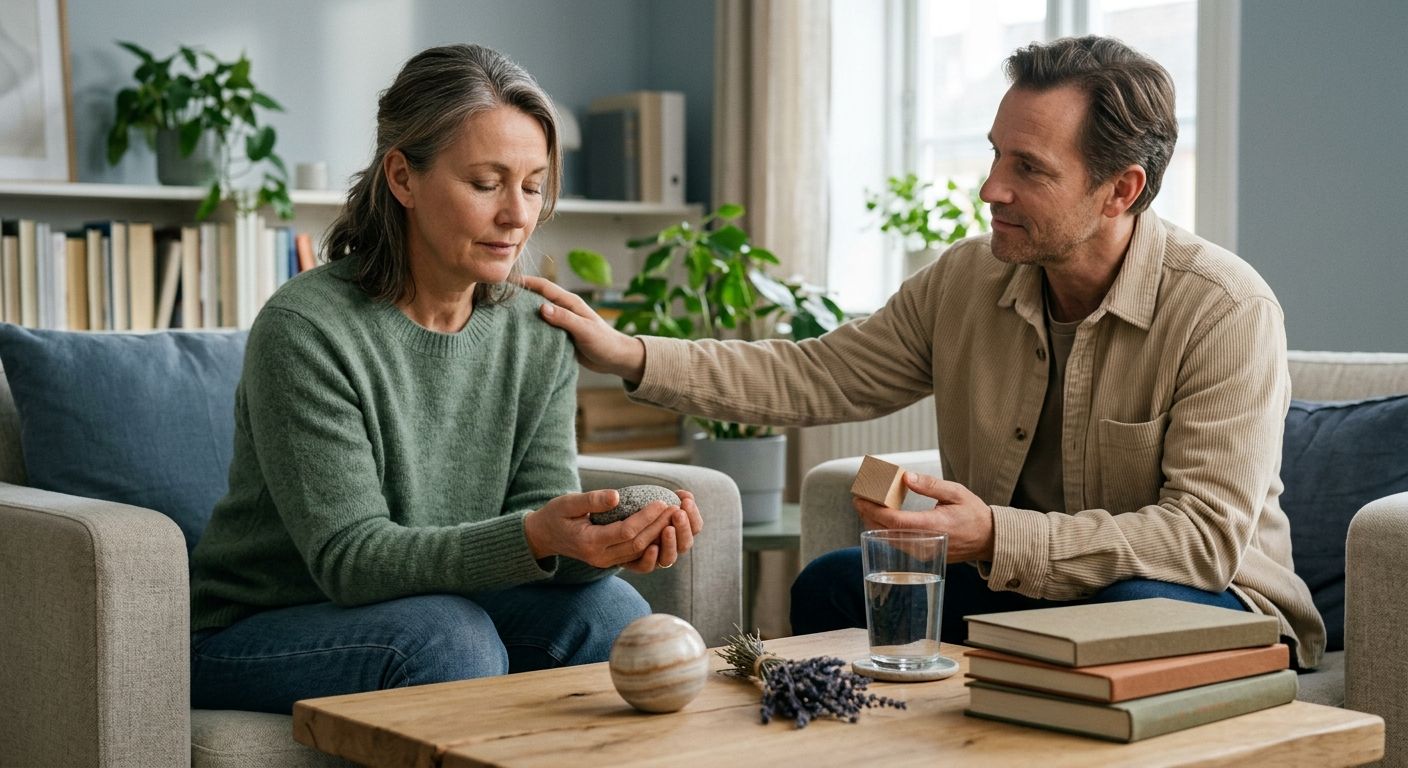
When a flashback hits, your body drops into a survival state faster than your thinking brain can catch up, and not every grounding technique works the same way for every nervous system. Best overall grounding technique for PTSD flashbacks: 5-4-3-2-1 sensory grounding. Fastest technique to start: scent grounding with a familiar, preselected aroma. Best for dissociation: orienting through visual scanning. Best for physiological spikes like a racing heart: the cold water technique. Best discreet option for anxious anticipation: paced box breathing.
- 5-4-3-2-1 sensory grounding wins overall for interrupting PTSD flashbacks in real time.
- Scent grounding is fast to begin because it requires no counting, movement, or sustained concentration.
- Research supports smell as a powerful memory cue, but not as a proven fastest PTSD treatment.
- Choose a familiar present-day scent carefully because odors can also trigger trauma memories.
- Grounding manages the moment; Somatic EMDR addresses the memory driving repeated flashbacks.
Why this matters
Grounding techniques are first-aid, not treatment. They pull you out of a flashback and back into the present room, which matters when you're driving, at work, or lying awake at 3am. What they don't do is touch the unprocessed memory that keeps triggering the flashback in the first place.
That distinction shows up constantly in trauma therapy work. Clients walk in with a toolbox of grounding skills from a previous therapist or a mental health app, and the skills genuinely help in the moment — but the flashbacks keep coming back at the same frequency, sometimes for years. Structured processing work, like the somatic EMDR sessions offered at EMDR with Kelli, is built to change that frequency, not just manage the spikes.
This guide ranks the grounding techniques with the strongest track record in trauma treatment as of 2026, tells you which nervous system state each one fits, and is honest about where grounding alone runs out of road.
What makes a grounding technique actually work
- Speed of effect — can it interrupt a flashback in under two minutes, or does it require calm focus you won't have mid-episode?
- Works for dissociation, hyperarousal, or both — some techniques calm a racing heart; others bring you back from feeling spaced out or unreal.
- No equipment required — a technique that needs props fails you the moment you're somewhere without them.
- Discreet enough for public use — flashbacks don't wait for privacy.
- Doesn't require calm to start it — the best grounding techniques work even when your hands are shaking and your thoughts are scattered.
- Backed by trauma treatment practice, not just wellness content.
- Low cognitive demand — can you begin while words, counting, and concentration are hard?
At a glance
| Technique | Best for | Standout feature | Key limitation |
|---|---|---|---|
| 5-4-3-2-1 sensory grounding | General flashback interruption | Uses all five senses, works almost anywhere | Slower for severe dissociation |
| Scent grounding / aromatherapy | Fast present-time orientation | Starts without counting, movement, or sustained focus | A trauma-linked odor can intensify a flashback |
| Cold water / ice technique | Racing heart, panic spikes | Fast physiological reset via cold shock | Not discreet in public, avoid with cardiac conditions |
| Orienting (visual scan) | Dissociation, feeling "not here" | Rebuilds present-time awareness fast | Less effective for pure panic symptoms |
| Butterfly hug / self-tapping | Emotional flooding | Bilateral stimulation calms the nervous system directly | Can feel awkward to learn alone |
| Paced box breathing | Anticipatory anxiety, early warning signs | Silent, works anywhere, no one notices | Too slow once a flashback is in full swing |
| Feet-on-floor / wall push | Feeling untethered from the body | Reconnects you to physical sensation instantly | Needs a stable surface nearby |
1. 5-4-3-2-1 sensory grounding: best grounding technique for general flashback interruption
This is the technique most trauma therapists teach first, and for good reason: it works across nearly every flashback presentation. You name five things you see, four you can touch, three you hear, two you smell, and one you taste, moving your attention through each sense in order.
5-4-3-2-1 pros:
- Works in almost any environment — car, office, grocery store
- Requires zero equipment or preparation
- Easy to teach to a partner or family member for support
- Effective for both mild dissociation and moderate panic
5-4-3-2-1 cons:
- Takes longer to land during severe dissociation, when counting itself feels hard
- Can feel mechanical the first several times before it becomes automatic
Verdict: use this first. It's the default technique to teach anyone with PTSD because it fits the widest range of flashback types.
2. Scent grounding: fastest technique to begin during a flashback
A familiar, deliberately chosen aroma can provide an immediate present-time cue when counting or speaking feels unavailable. This is scent grounding: using smell to orient to safety now. Aromatherapy may be part of it, but the grounding effect depends on the scent's personal association, not on any one essential oil treating PTSD.
A 2016 review by PTSD researchers Judith Daniels and Eric Vermetten reported that odors can trigger involuntary trauma memories and may also reduce emotional arousal when used as grounding stimuli. A 2018 controlled study of 170 participants found that childhood-related odors elicited richer autobiographical memories than images. Together, those findings support smell as a powerful memory pathway, but they do not prove that scent stops PTSD flashbacks faster than every other technique.
A 2023 review of 44 randomized trials found that essential oils reduced anxiety across varied study populations. That evidence applies to anxiety symptoms generally; it does not establish aromatherapy as a treatment for PTSD or as a replacement for trauma-focused care.
How to use scent grounding:
- Choose a familiar scent linked to your present life, such as coffee, soap, citrus peel, or a personally familiar aroma.
- Test it while calm. Do not use a scent connected to the traumatic event, even if other people describe it as relaxing.
- During a flashback, notice the scent and name it: "I smell coffee. I am in my current home. Today is [date]."
- Stop if the smell increases distress, nausea, breathing symptoms, or a sense of being pulled further into the memory.
Scent grounding pros:
- Starts without counting, movement, or sustained concentration
- Portable and discreet when prepared in advance
- Pairs a sensory cue with present-time facts
- Can help when visual or verbal grounding feels inaccessible
Scent grounding cons:
- Smell is also a strong trauma trigger, so the wrong odor can worsen a flashback
- Evidence is indirect; no study establishes it as the fastest PTSD grounding method
- Fragrances can aggravate asthma, migraine, nausea, or sensory sensitivity
Verdict: use scent as your fastest-to-start tool, not as a universal cure. Choose the aroma while calm, keep it separate from trauma-linked smells, and pair it with present-time orientation.
3. Cold water or ice technique: best for a racing heart during a flashback
Pressing an ice cube or cold water against your wrists, face, or the back of your neck triggers the mammalian dive reflex, slowing your heart rate within a minute or two. This one is built for the physiological side of a flashback — the pounding chest, the shallow breathing.
Cold water technique pros:
- Produces a fast, measurable drop in heart rate
- Simple to keep tools for — a cold pack, ice, or splashing water at a sink
- Doesn't require you to focus your thoughts, which helps when concentration is gone
Cold water technique cons:
- Not discreet in a meeting or classroom
- Should be avoided or modified for anyone with a heart condition — check with a doctor first
Verdict: keep it in your kit for the moments panic spikes hardest. Pair it with a slower technique once your heart rate settles.
4. Orienting through visual scanning: best for dissociation and feeling "not here"
Orienting means slowly turning your head and naming objects in the room out loud — "blue chair, window, door, lamp" — while noticing that you are safe, in this place, in this year. It directly targets dissociation, which is a different nervous system state than panic and needs a different fix.
Orienting technique pros:
- Rebuilds present-time and present-place awareness quickly
- Works well for the foggy, unreal feeling that accompanies dissociative flashbacks
- Can be done seated or standing, with eyes open
Orienting technique cons:
- Less useful when the primary symptom is a racing heart rather than feeling checked out
- Speaking out loud isn't always possible in public settings
Verdict: use this when you feel unreal or far away, not when you feel panicked.
5. Butterfly hug and self-tapping: best for emotional flooding
Crossing your arms over your chest and alternately tapping your shoulders — the butterfly hug — uses bilateral stimulation, the same left-right pattern used in EMDR sessions. It's one of the few grounding techniques that works on the nervous system directly rather than just redirecting attention.
Butterfly hug pros:
- Calms intense emotional flooding, not just cognitive distraction
- Discreet enough to do with arms crossed in most public settings
- Familiar to anyone who has done EMDR work, since it mirrors bilateral stimulation
Butterfly hug cons:
- Some people find the physical self-touch uncomfortable at first
- Takes practice outside of a flashback to feel natural in the moment
Verdict: strong option once you've practiced it calm, so it's automatic under stress.
6. Paced box breathing: best for catching a flashback early
Inhale for four counts, hold for four, exhale for four, hold for four. Box breathing works best in the window before a flashback fully takes hold, when you notice the early warning signs — tight chest, racing thoughts, a familiar dread.
Box breathing pros:
- Completely silent and invisible to anyone around you
- No equipment, no movement required
- Doubles as a daily nervous-system regulation practice, not just crisis response
Box breathing cons:
- Too slow once a flashback is already at full intensity
- Requires enough presence of mind to count, which isn't always available
Verdict: excellent for prevention, weak as a rescue tool mid-flashback.
7. Feet on the floor or pushing against a wall: best for feeling untethered from your body
Pressing your feet firmly into the ground, or pushing your palms against a wall with real effort, gives your nervous system concrete proprioceptive feedback — a signal that you have a body, and that body is safe right now.
Feet/wall push pros:
- Immediate physical sensation, no counting or naming required
- Works well combined with any of the techniques above
- Good for people who dissociate from their body specifically, not just their surroundings
Feet/wall push cons:
- Needs a stable floor or wall within reach
- Alone, it's often not enough for a full flashback — best used as a starting point
Verdict: solid supporting technique, rarely enough on its own.
“Grounding brings you back into the room; it does not process the trauma memory itself.”
How this list was ranked
Each technique was weighed against seven criteria: speed, whether it addresses dissociation or hyperarousal, equipment needs, discretion, whether it works without a calm starting state, cognitive demand, and its use in trauma treatment settings rather than general wellness content. 5-4-3-2-1 sensory grounding stays first because it performs well across the full range. Scent grounding earns the fastest-to-start distinction because it can begin without counting or movement, while the research is not strong enough to call it the fastest technique to stop a PTSD flashback.
Which grounding technique should you use?
If you only learn one, learn 5-4-3-2-1 — it covers the widest range of flashback presentations. Add a carefully chosen present-day scent for moments when counting is unavailable, cold water for panic spikes, and orienting for dissociation. In 2026, scent is the most overlooked sensory option in this list, but it must be selected carefully because smell can ground you or pull you deeper into a trauma memory.
But grounding has a ceiling. If flashbacks are happening weekly, or grounding techniques stopped moving the needle months ago, that's a sign the underlying trauma memory needs processing, not just managing. Somatic EMDR, offered through weekly sessions or intensives at EMDR with Kelli, works directly with the nervous system to reduce how often and how intensely those memories fire in the first place.
Ready to address the root of the flashbacks?
Somatic EMDR sessions and intensives for PTSD and complex trauma in San Diego County.
FAQ
What is the best grounding technique for PTSD flashbacks?
The 5-4-3-2-1 sensory grounding technique is the best all-around option because it works for both dissociation and panic symptoms and needs no equipment. Scent grounding is often faster to start when counting feels unavailable, while cold water and orienting fit specific symptoms.
Is aromatherapy proven to stop PTSD flashbacks?
No. Research supports smell as a powerful memory and grounding cue, and broader trials suggest some essential oils can reduce anxiety, but aromatherapy has not been proven to stop PTSD flashbacks or work faster than every other grounding method. Choose a familiar present-day scent carefully because odors can also trigger trauma memories.
How long does it take for grounding techniques to work during a flashback?
Most grounding techniques take one to three minutes to start reducing flashback intensity. The cold water technique tends to work fastest for physiological symptoms like a racing heart, while sensory grounding can take a bit longer.
Can grounding techniques stop flashbacks completely?
Grounding techniques interrupt a flashback in the moment but do not reduce how often flashbacks happen over time. Processing the underlying trauma memory, through approaches like somatic EMDR, is what changes flashback frequency long term.
Is the butterfly hug the same as EMDR?
No. The butterfly hug uses the same bilateral tapping pattern found in EMDR sessions, but it's a self-soothing grounding tool, not trauma processing. Full EMDR therapy pairs bilateral stimulation with structured work on a specific traumatic memory.
What should I do if grounding techniques stop working?
If grounding techniques that used to help no longer reduce flashback intensity, it's a sign the underlying trauma memory needs direct processing. A trauma therapist trained in EMDR or somatic approaches can assess whether weekly sessions or an intensive format fits your situation.
Are grounding techniques safe to use alone at home?
Most grounding techniques listed here, including 5-4-3-2-1, orienting, and box breathing, are safe to practice alone. The cold water technique should be modified or avoided if you have a heart condition, so check with a doctor first.
How is dissociation different from a panic-type flashback?
Dissociation feels like being foggy, unreal, or disconnected from your surroundings, while a panic-type flashback comes with a racing heart and physical alarm. Orienting techniques work better for dissociation; cold water and breathing work better for panic symptoms.
One last thing
The technique that works best for you often depends on which nervous system state you land in most — dissociative or hyperaroused — and most people default to only practicing the one that matches their most recent bad episode. Practice at least one technique from each category while calm: a safe familiar scent for rapid orientation, cold water for panic, and visual orienting for dissociation. Smell deserves a place in the kit precisely because it is powerful; that same power is why the scent must be chosen before a crisis, not during one.