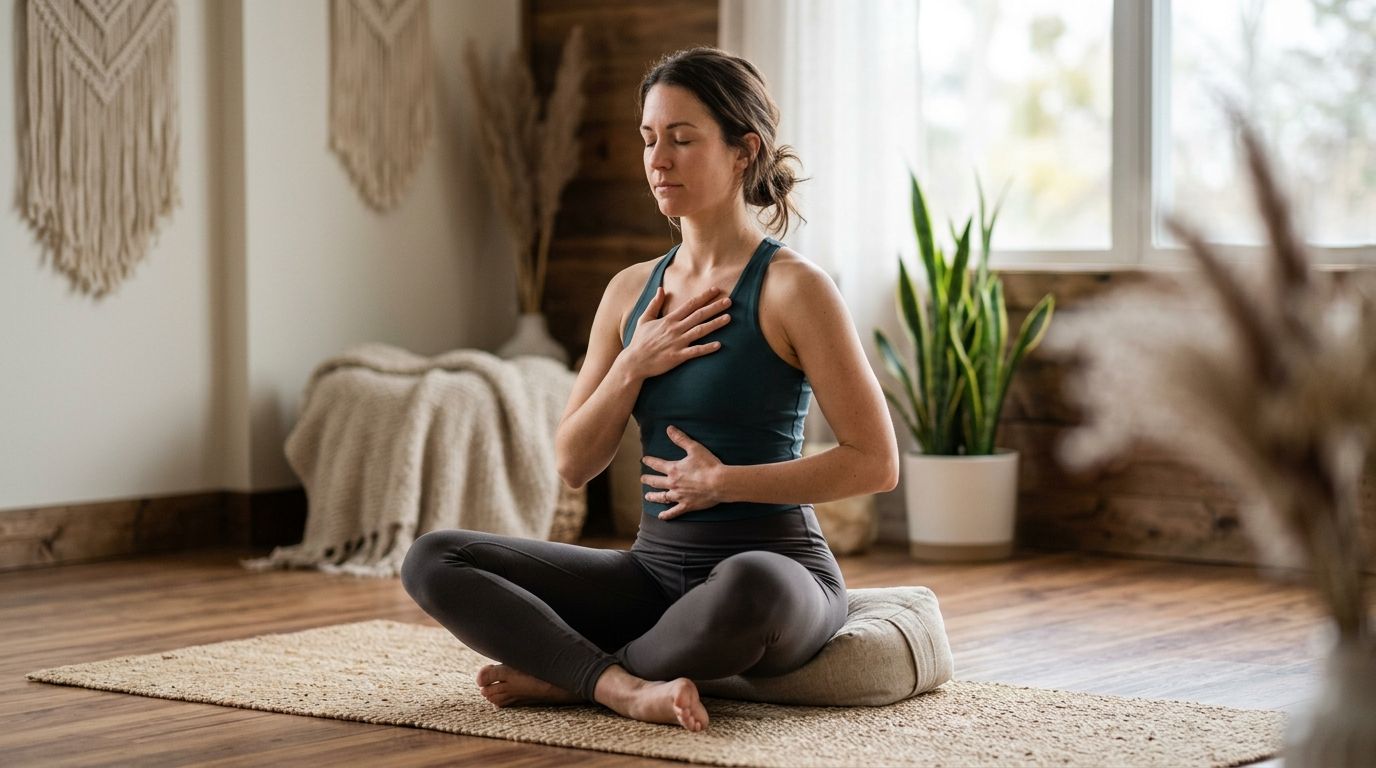
Best overall for anxiety relief: the physiological sigh. Best for dissociation or derealization: the orienting exercise. Best no-equipment daily practice: extended exhale breathing. Best for anxiety tied to trauma processing: the butterfly hug. Each works on the nervous system directly instead of arguing with the anxious thought, and each has a distinct clinical use.
- The physiological sigh is the fastest reset for acute panic — a 2023 Stanford study backs it.
- Extended exhale breathing is the best somatic therapy exercise for anxiety relief you can do daily without props.
- The orienting exercise works in under a minute for dissociation and derealization.
- The butterfly hug uses bilateral stimulation and pairs naturally with EMDR processing.
- The container exercise handles intrusive thoughts before sleep but is not a substitute for ERP with OCD.
Why this matters
Anxiety lives in the body before it shows up as a thought loop — a racing heart, shallow breath, tight shoulders. Somatic therapy exercises work the physiology first, which is why EMDR with Kelli treats body-based regulation as a companion to trauma processing, not a substitute for it.
The distinction that matters in 2026: some of these exercises calm a spike in the moment, and some rewire the baseline over weeks. Confusing the two is the most common mistake people make when they try one technique once, decide it "doesn't work," and quit.
What makes the best somatic therapy exercise for anxiety
- Engages the autonomic nervous system directly — not just redirecting attention away from the anxious thought
- Takes under five minutes so it's usable mid-panic, not just in a scheduled session
- Requires no equipment, app, or quiet room to actually get used under stress
- Has a clear start and stop so the body registers completion — critical for anyone with a trauma history
- Matches the specific presentation — panic, dissociation, chronic tension, or intrusive thoughts each need a different tool
- Safe to self-administer for most people, with a few exceptions noted below
At a glance
| Exercise | Best for | Standout feature | Key limitation |
|---|---|---|---|
| Physiological sigh | Acute panic spikes | Fastest reset, published research behind it | Doesn't touch underlying trauma |
| Extended exhale breathing | Daily baseline regulation | No equipment, works anywhere | Fades without consistent practice |
| Orienting exercise | Dissociation, derealization | Re-engages the senses in under a minute | Weaker for pure muscle tension |
| Butterfly hug | Trauma-adjacent anxiety | Bilateral stimulation mirrors EMDR | Can feel exposing at first |
| Self-holding (hand on heart) | Shame-based anxiety | Discreet, no visible movement needed | Effect is subtle, easy to dismiss |
| Container exercise | Intrusive thoughts before sleep | Creates distance from looping thoughts | Not a replacement for ERP with OCD |
1. Physiological sigh: best somatic exercise for acute panic spikes
Two inhales through the nose — one long, one short on top of it — followed by one slow, long exhale through the mouth. A 2023 Stanford study published in Cell Reports Medicine found that people who practiced this pattern for five minutes a day over one month reported lower anxiety and improved mood compared to mindfulness meditation over the same period.
Physiological sigh pros:
- Works within one or two cycles for most people
- No counting or app required once it's learned
- Backed by a controlled research trial, not just anecdote
Physiological sigh cons:
- Doesn't address the underlying trigger, only the spike
- Can feel awkward in public until it's practiced privately first
Best for: anyone whose anxiety shows up as a sudden physical surge — racing heart, chest tightness, the feeling of losing control in the next thirty seconds. Use daily during a spike; it's the first tool to reach for.
2. Extended exhale breathing: best somatic exercise for daily regulation
Inhale for a count of four, exhale for a count of six or eight — the longer exhale is what activates the parasympathetic response. This is the baseline practice, not the emergency one; it works slower and more subtly than the physiological sigh.
Extended exhale breathing pros:
- Builds a lower resting anxiety baseline over weeks
- Doubles as a grounding tool before appointments, meetings, or conflict
- Simple enough to teach in under a minute
Extended exhale breathing cons:
- Benefits fade within days if practice stops
- Feels too slow for someone already in a full panic response
Best for: people managing generalized anxiety day to day, not a single acute episode. Use it once or twice daily as a maintenance practice, not a crisis tool.
3. Orienting exercise: best somatic exercise for dissociation and derealization
Name five things you can see, three things you can hear, and one thing you can physically touch right now. This pulls attention out of an internal spiral and back into the present physical environment — it's one of the fastest ways to interrupt a dissociative episode.
Orienting exercise pros:
- Works in under a minute
- Requires nothing but your own senses
- Effective for the "floaty" or "not real" feeling anxiety can produce
Orienting exercise cons:
- Less useful when the primary problem is muscle tension, not disconnection
- Some people need a second person's voice to guide it the first few times
Best for: anxiety that comes with feeling detached, foggy, or outside your own body. Use it the moment dissociation starts, not after it's already deep.
4. Butterfly hug: best somatic exercise for trauma-adjacent anxiety
Cross your arms over your chest, hands on opposite shoulders, and alternate a slow tapping rhythm. The bilateral stimulation mirrors the eye-movement component used in EMDR processing, which is why it's often taught alongside somatic EMDR work rather than as a standalone fix.
Butterfly hug pros:
- Bilateral stimulation has a calming effect distinct from breathing alone
- Can be done seated, standing, or lying down without drawing attention
- Complements ongoing trauma processing between sessions
Butterfly hug cons:
- Some people find self-touch uncomfortable at first, especially with a trauma history
- Not a substitute for full EMDR processing when trauma is the root cause
Best for: anxiety that spikes around trauma-related triggers rather than general stress. Use it as a between-session tool if you're already working with a somatic EMDR therapist; skip it as a first exercise if self-touch feels unsafe.
5. Self-holding: best somatic exercise for shame-based anxiety
One hand on the chest, one hand on the belly, applying gentle pressure while breathing slowly. It's the quietest exercise on this list — nothing visible happens from the outside — which makes it useful in shame-driven anxiety where being watched or noticed makes things worse.
Self-holding pros:
- Completely discreet in public or professional settings
- Directly counters the physical collapse that shame anxiety often produces
- Pairs well with slow breathing for a stronger effect
Self-holding cons:
- Effect is subtle and easy to underestimate on the first try
- Takes longer to feel a shift than the physiological sigh
Best for: anxiety tangled up with shame, self-criticism, or the urge to disappear. Use it consistently for a week before deciding whether it helps.
6. Container exercise: best somatic exercise for intrusive thoughts before sleep
Imagine a container — a box, a vault, a locked room — and mentally place the looping thought or worry inside it, to be revisited at a specific time tomorrow. It's a visualization, not a breathing pattern, and it works by creating psychological distance rather than physiological calm.
Container exercise pros:
- Effective for the 11pm thought spiral that keeps you awake
- No physical movement needed, works lying in bed
- Gives a concrete sense of control over when to think about something
Container exercise cons:
- Not built to treat OCD-driven intrusive thoughts on its own — that needs ERP
- Some people find visualization difficult without practice
Best for: general anxious rumination at bedtime, not compulsive intrusive thoughts tied to OCD. Use it nightly for rumination; skip it as OCD treatment and ask about ERP instead.
How this list was ranked
Each exercise was scored against the six criteria above: nervous-system engagement, speed, accessibility, a clear endpoint, match to a specific anxiety presentation, and self-administration safety. The physiological sigh ranked first because it's the only one with a published controlled trial behind it as of 2026; the rest are ranked by how narrowly and reliably they solve one specific problem.
Want guidance beyond self-help exercises
Somatic EMDR sessions and intensives are available in Escondido and San Diego County.
Which somatic therapy exercise should you choose?
If you only take one thing from this list: use the physiological sigh for spikes and extended exhale breathing as your daily baseline. Add the orienting exercise if dissociation is part of your pattern, and the butterfly hug if you're already doing trauma processing work. The container exercise is the right call for bedtime rumination, but it won't touch true OCD-driven intrusive thoughts — that needs a therapist trained in ERP, not a visualization exercise.
None of these replace processing the trauma underneath chronic anxiety. They regulate the nervous system in the moment; somatic EMDR work addresses why the nervous system is on alert in the first place.
FAQ
What's the best somatic therapy exercise for anxiety relief?
The physiological sigh — a double inhale followed by one long exhale — is the fastest reset for an acute anxiety spike, backed by a 2023 Stanford study. Extended exhale breathing works better as a daily baseline practice rather than a crisis tool.
Is EMDR better than breathing exercises for anxiety?
They do different jobs. Breathing exercises calm the nervous system in the moment; EMDR processes the underlying trauma driving the anxiety, which breathing alone doesn't touch.
How long does it take for somatic exercises to reduce anxiety?
The physiological sigh can shift a panic spike within one or two cycles. Daily baseline practices like extended exhale breathing showed measurable mood improvement over one month in the Stanford trial.
Can I do somatic exercises without a therapist?
Most of the exercises here, including breathing patterns and orienting, are safe to self-administer. The butterfly hug can bring up trauma material for some people, so it's better used alongside a somatic EMDR therapist if that happens.
What is the physiological sigh?
It's a breathing pattern of two inhales through the nose followed by one long exhale through the mouth. A 2023 Stanford study found five minutes of daily practice reduced anxiety more than mindfulness meditation over one month.
Do somatic exercises help with OCD?
They can reduce general anxious arousal, but intrusive thoughts tied to OCD respond specifically to ERP (exposure and response prevention), not visualization or breathing exercises alone.
What's the difference between somatic therapy and talk therapy?
Talk therapy works primarily through cognitive insight and conversation. Somatic therapy works through the body's physical state first, on the theory that anxiety and trauma get stored in the nervous system, not just in thought patterns.
Is the butterfly hug the same as EMDR?
No. The butterfly hug uses bilateral tapping as a self-soothing tool, similar in principle to the bilateral stimulation used in EMDR, but it's not full EMDR processing and doesn't require a therapist to perform.
One last thing
The container exercise gets dismissed the most often because it feels too simple to work — no breath control, no movement, just a mental image. That's exactly why it works for rumination: it doesn't ask an already-overloaded nervous system to analyze or fix anything, just to set the thought down until a scheduled time. In 2026, that's still one of the most underused tools on this list.