
Best overall: pause-and-return. Best for feeling misunderstood: speaker–listener turns. Best for a difficult conversation before it starts: a grounding check-in. The best communication exercises for couples healing from trauma give both people a way to notice activation, speak without pressure and stop when the conversation no longer feels safe.
- Pause-and-return is the best communication exercise for couples healing from trauma when conflict becomes overwhelming.
- Speaker–listener turns help when interruptions make either partner feel unheard.
- A grounding check-in helps both partners decide whether they are ready to talk.
- Skip joint exercises when there is intimidation, coercion or fear of retaliation.
Why this matters
A conversation about a missed text or an unfinished chore can feel much bigger when it touches an earlier experience of abandonment, threat or betrayal. The aim is not to win the conversation; it is to keep enough choice and safety in it for both people to participate. If that is not possible, pause the exercise.
In 2026, use communication exercises as practice, not as a way to process traumatic memories at home. EMDR with Kelli offers Somatic EMDR intensives and weekly sessions for adults dealing with trauma, anxiety and relationship issues. Those individual therapy services are distinct from the couples exercises below.
If one partner fears the other's reaction, faces threats, or is pressured to disclose experiences they do not want to share, do not treat a joint exercise as a safety plan. Seek confidential individual support instead. Both people must be free to decline an exercise without punishment.
What makes the best communication exercise for trauma recovery?
Judge each practice by what happens when a conversation gets hard, not by how thoughtful it sounds when everyone is calm:
- A clear stopping point: Either person can end the exercise without having to defend the decision.
- A specific task: Each partner knows whether to speak, listen, make a request or pause.
- Choice about disclosure: Neither person has to explain their trauma history to use it.
- Attention to body cues: Tightness, numbness, racing thoughts or an urge to leave are reasons to check capacity, not proof that someone is wrong.
- A path back to the topic: Pausing helps only when both people know whether and how they will revisit the conversation.
- Room for disagreement: The goal is an understandable request, not forced agreement.
Start with the least demanding exercise that fits the moment. A grounding check-in belongs before a difficult topic; repair statements belong after a specific misstep. In 2026, no communication script should override a partner's right to stop.
At a glance: which exercise fits the moment?
| Exercise | Best for | What you do | Key limitation |
|---|---|---|---|
| Pause-and-return | Escalating conversations | Stop, name a return plan and revisit the topic | A pause without follow-through can feel like withdrawal |
| Speaker–listener turns | Repeated interruptions | Take turns speaking and reflecting | Reflection can sound mechanical if it replaces genuine listening |
| Grounding check-in | Deciding whether to begin | Notice body cues and choose whether to talk | Grounding does not make an unsafe conversation safe |
| Specific repair statement | Owning a clear misstep | Name the action, its impact and a change | It cannot demand forgiveness |
| Shared trigger map | Identifying repeat conflict patterns | Name cues, responses and helpful requests | It can expose vulnerable information too quickly |
| One-request boundary practice | Making a practical change | State a limit and one observable request | A request cannot control the other person's response |
1. Pause-and-return: best for escalating conversations
Pause-and-return gives an argument a stopping point without pretending the issue is resolved. When either person notices that they cannot listen or choose their words, they can call a pause and state when they will check back in. EMDR with Kelli is best suited to individual Somatic EMDR work; for a couple's immediate communication practice, pause-and-return is the default starting point.
Try: “I want to discuss this, and I cannot do it well right now. Can we pause and check in again at 6 p.m.?” During the pause, each person attends to their own needs rather than preparing a closing argument. At the agreed time, either resume or agree on another specific time; do not silently let the subject disappear.
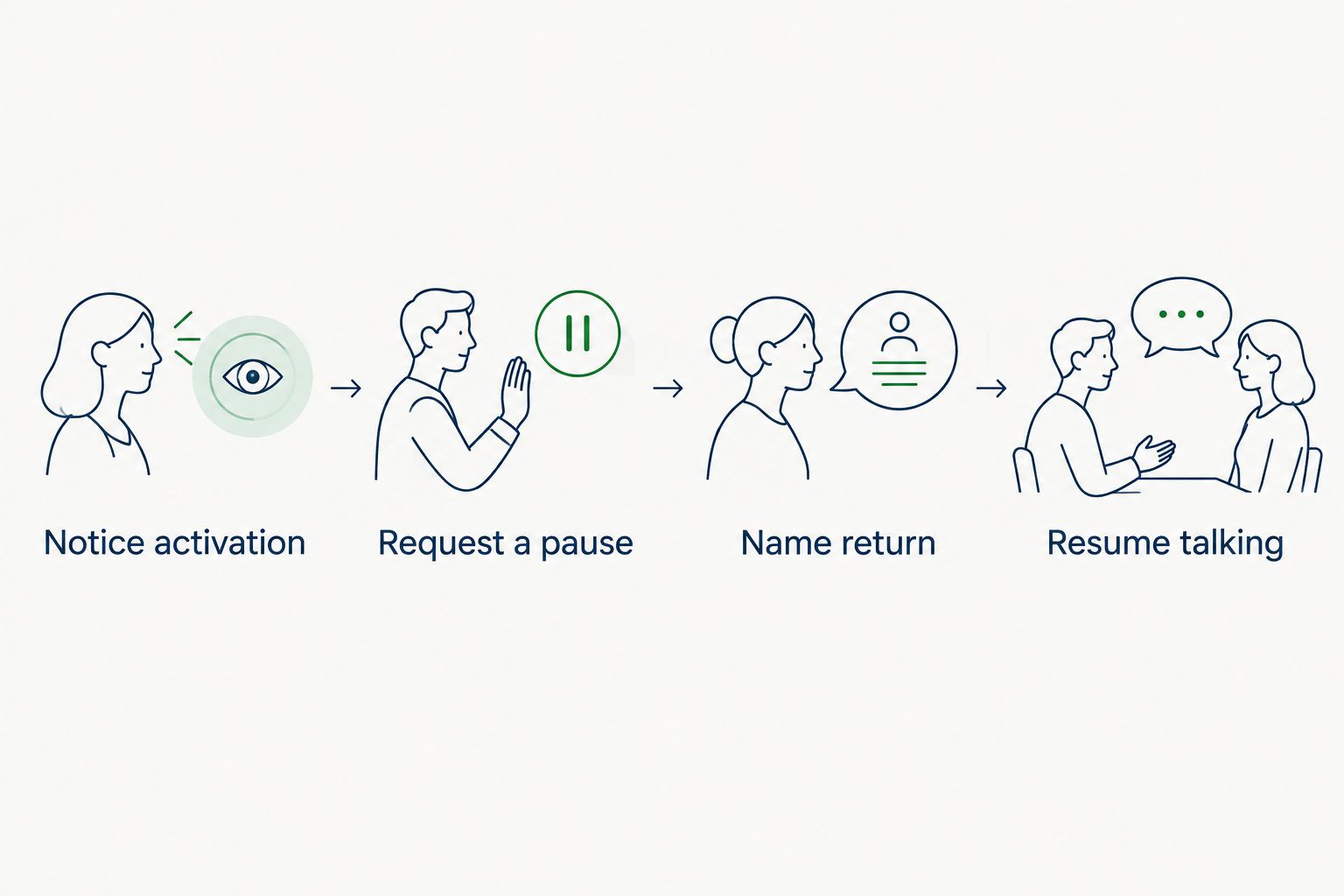
A simple sequence keeps the pause from becoming another source of conflict:
- Notice activation: Recognize when listening or speaking has become difficult.
- Request a pause: Say plainly that you are stopping this discussion for now.
- Name return: Agree on a time to check whether you can continue.
- Resume talking: Return to the original issue without demanding instant resolution.
Pause-and-return pros:
- Either partner can interrupt escalation without having to prove a point.
- A return plan distinguishes a pause from abandoning the discussion.
- It does not require disclosure of trauma details.
Pause-and-return cons:
- Repeated pauses without a return can erode trust.
- It does not resolve the disagreement by itself.
Best for: Partners who still want to address the issue but cannot do it constructively in the moment. Verdict: Buy in only if both partners can call the pause and expect the return plan to be honored.
2. Speaker–listener turns: best for repeated interruptions
Speaker–listener turns separate being heard from finding a solution. One partner describes a current experience while the other reflects the main point before responding. Then they switch. A reflection can be as simple as: “You felt alone when I changed our plans without telling you. Did I get that right?”
Set a 2-minute speaking turn if an open-ended conversation feels difficult. The listener's job is to check understanding, not rebut, diagnose or explain what the speaker really meant. The speaker can correct the summary without being required to persuade the listener that their feelings are justified.
Keep the topic small: choose one recent interaction rather than an entire relationship history. If either person becomes flooded, use pause-and-return instead of pushing through the remaining turn. In 2026, a timed turn is a boundary for the exercise, not a test of who communicates better.
Speaker–listener turns pros:
- Each partner gets uninterrupted speaking time.
- Reflecting the point exposes misunderstandings before they grow.
- A narrow topic makes the task easier to repeat.
Speaker–listener turns cons:
- Scripted reflection can feel dismissive when the listener is not engaged.
- Taking turns does not make harmful behavior acceptable.
Best for: Partners whose discussions repeatedly become interruptions or arguments about what was said. Verdict: Buy in when both partners can listen without turning the reflection into a rebuttal.
3. Grounding check-in: best before a difficult conversation
A grounding check-in asks whether both partners have enough capacity to start. Each person names what they notice in their body, whether they want to talk now and what would help them participate. For example: “My shoulders are tight. I can talk about tonight's plans, but I am not ready to discuss last week's argument.”
Take 1 minute separately to notice physical sensations, then share only what you choose. You do not need to explain why a sensation appeared or connect it to a traumatic event. A partner who says “not now” can suggest a later check-in; the other partner can still decide what support they need in the meantime.
A check-in is a consent question, not a way to certify that a conversation is safe. If there is intimidation or fear of retaliation, noticing your breath will not fix the underlying problem. Stop the joint exercise and seek individual support.
Grounding check-in pros:
- It makes room to notice body cues before an argument starts.
- Each person can set a limit on the topic.
- It requires no account of past trauma.
Grounding check-in cons:
- One partner can misuse it to pressure the other to explain a private reaction.
- It cannot resolve coercion or make disclosure safe.
Best for: Partners deciding whether now is a workable time to discuss a hard topic. Verdict: Buy in when either person can answer “not now” without consequences.
4. Specific repair statement: best after a clear misstep
A repair statement names a behavior without asking the hurt partner to make the discomfort disappear. Use three parts: what you did, what impact you understand and what you will change. For example: “I interrupted you while you were describing the appointment. I understand that you felt shut out. Next time, I will wait until you finish.”
The listener can say whether that account matches their experience. They are not required to accept the apology on the spot. If the person making the repair disagrees with the impact, they can ask a genuine question later rather than turning the repair into a defense.
Keep the change observable and within your control. “I will never upset you again” is not a workable commitment; “I will tell you when I need to pause instead of walking away without a word” identifies an action. In 2026, accountability still matters when trauma helps explain why a reaction occurred.
Specific repair statement pros:
- It focuses on behavior rather than character.
- It makes a future change explicit.
- It leaves the other person free to describe their experience.
Specific repair statement cons:
- A polished statement means little without changed behavior.
- Repeated harm cannot be repaired by requesting quick forgiveness.
Best for: Partners addressing one identifiable action after both are ready to talk. Verdict: Buy in when the speaker can name a change without demanding reassurance.
5. Shared trigger map: best for recurring patterns
A shared trigger map records a pattern without assigning blame for having a nervous-system response. Each partner can name a present-day cue, the response they notice and a request that might help. One entry might read: “When plans change without notice, I feel tense and start asking repeated questions. Please tell me when a plan changes.”
Keep the map about current interactions. No one needs to supply a traumatic memory, diagnosis or explanation for every reaction. You can each write 3 short lines privately, then share only the parts you want the other person to know. If the conversation becomes an interrogation about the origin of a trigger, stop.
A map helps a couple see where their responses collide: one person asks for detail while the other pulls away. It does not establish whose interpretation is correct. Revisit an entry only when both people consent, and use the specific request to decide what can change in daily communication.
Shared trigger map pros:
- It separates a current cue from a partner's assumed intent.
- It turns a vague pattern into a discussable request.
- Each person controls how much personal context they share.
Shared trigger map cons:
- Written details can feel exposing if privacy is not respected.
- Mapping a pattern does not process the trauma behind it.
Best for: Partners who recognize the same conflict pattern but struggle to describe it calmly. Verdict: Hold until both people can share without pressure or blame.
6. One-request boundary practice: best for everyday changes
A boundary names what you will do or accept; a request tells your partner what action would help. Practice saying one of each without an accusation. For example: “I will not continue a conversation while we are shouting. Please speak to me without raising your voice, or we can pause.”
Make the request specific enough that both people can recognize it in action. “Care more” leaves the other person guessing; “Tell me when you need to change our plans” gives them something to respond to. Then listen to their answer. A request is an invitation to discuss behavior, not a guarantee of agreement.
If you cannot maintain a stated boundary safely, do not rely on a communication script to protect you. Seek confidential support suited to your situation. For disagreements without intimidation, this exercise can keep the discussion on a practical next step rather than a debate about motives.
One-request boundary practice pros:
- It distinguishes your limit from the action you are asking for.
- A specific request is easier to understand than a character judgment.
- It gives both partners room to respond honestly.
One-request boundary practice cons:
- The other person can decline the request.
- A script cannot make an unsafe partner respect a boundary.
Best for: Partners who know what needs to change but keep making broad or conflicting demands. Verdict: Buy in when stating a limit is safe and the request concerns observable behavior.
How these exercises were ranked
The ranking favors a clear stopping point, consent and a small task over emotional intensity. Pause-and-return comes first because it gives the other exercises a way to end when someone loses the capacity to participate. Speaker–listener turns and grounding check-ins address different problems: one limits interruption; the other tests readiness.
This is a practical ranking for 2026, not a claim that one exercise treats PTSD or replaces therapy. The last three practices ask for more reflection or negotiation, so they fit best after both partners can pause and listen without punishment.
Which communication exercise should you choose?
Choose pause-and-return first if conversations regularly escalate. If the problem is interruption rather than escalation, choose speaker–listener turns. Start with a grounding check-in when you are unsure whether either of you is ready; use a repair statement after a specific hurt, a trigger map for a recurring pattern and a boundary request for a practical change.
If a partner controls whether you can stop, speak or seek help, skip these joint exercises. EMDR with Kelli provides individual Somatic EMDR therapy and intensives for adults with trauma and relationship concerns in Escondido and San Diego County; that is not a claim that EMDR with Kelli offers couples sessions. In 2026, the right next step may be individual support rather than another conversation at home.
FAQ
What are the best communication exercises for couples healing from trauma?
Pause-and-return is the best starting exercise when conversations escalate. Speaker–listener turns help with interruptions, while a grounding check-in helps partners decide whether to talk at all.
How do you pause an argument without avoiding it?
Say that you are pausing and agree on a specific time to check back in. At that time, resume the topic or clearly agree on another time rather than letting it disappear.
Should couples discuss traumatic memories during a communication exercise?
No, disclosure of traumatic memories is not required for these exercises. Keep the conversation on current interactions and choose what personal information you want to share.
Is a grounding check-in better than speaker–listener turns?
A grounding check-in is better for deciding whether both partners are ready to talk; speaker–listener turns are better when interruptions prevent understanding. Neither makes an intimidating conversation safe.
What if my partner refuses to pause an argument?
Do not treat a joint exercise as a fix for refusal to respect a stopping point. If you fear retaliation or cannot stop safely, seek confidential individual support.
Can these exercises replace trauma therapy?
No, these exercises practice communication; they do not replace assessment or treatment for trauma. Individual therapy can address trauma and relationship concerns without requiring a partner to participate.
Does EMDR with Kelli offer couples therapy?
The provided practice description identifies individual Somatic EMDR intensives and weekly sessions for adults with trauma and relationship concerns. It does not identify a couples therapy service.
One last thing
The most useful phrase in a hard conversation may be a return time, not a perfect explanation. A pause that both people can call and revisit gives every other exercise a better chance to work. That remains true in 2026, even when you know the right words but your body is telling you to stop.