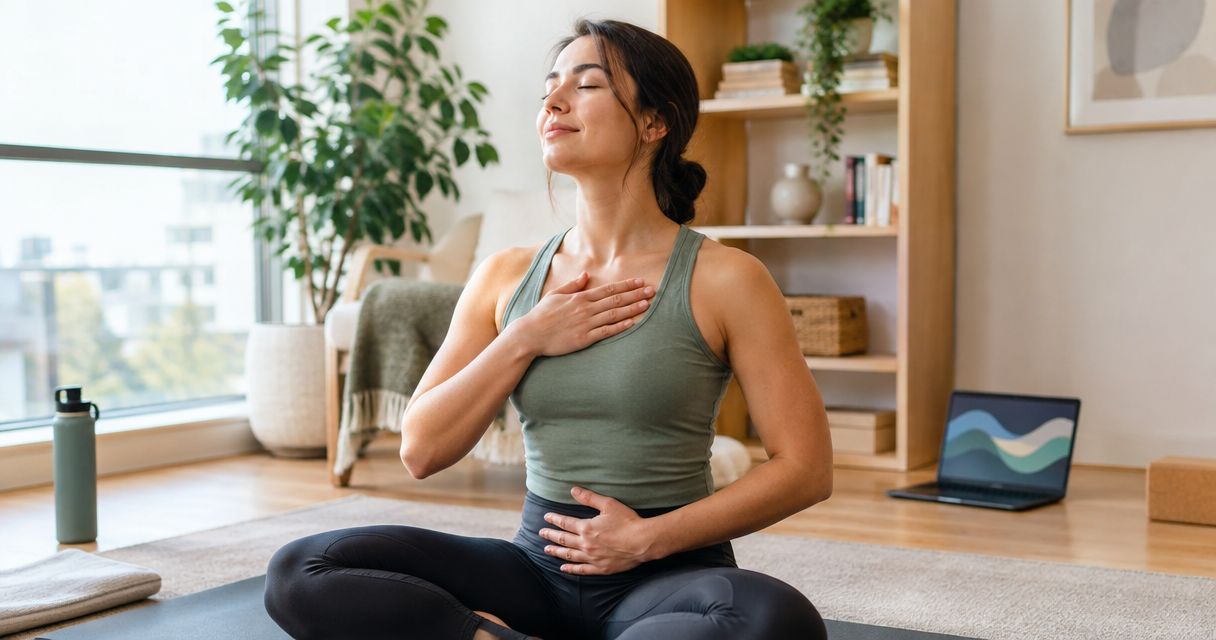
Somatic exercises for nervous system regulation work by changing physical state first and thought patterns second — orienting, breathwork, and bilateral tapping all shift the body out of fight-or-flight before you try to think your way out of it. Best overall: orienting (the fastest, most portable reset). Best for flashbacks: 5-4-3-2-1 grounding. Best for panic spikes: extended-exhale breathing. Best for processing between EMDR sessions: the butterfly hug.
- Orienting is the best overall somatic exercise for nervous system regulation because it works in under 60 seconds with no equipment.
- 5-4-3-2-1 grounding is the strongest choice for flashbacks and dissociation in 2026 clinical practice.
- Extended-exhale (Voo) breathing directly engages the vagus nerve for racing heart rate and panic spikes.
- The butterfly hug gives bilateral stimulation between EMDR sessions but doesn't replace full reprocessing work.
- Pendulation and TRE-style shaking carry the most benefit but need the most guidance to use safely.
Why nervous system regulation exercises matter
A dysregulated nervous system doesn't respond to logic — it responds to sensation, breath, and movement. Somatic exercises give you a way to signal safety to the body directly, which is why they show up across trauma-focused approaches including Somatic EMDR rather than as a stand-alone alternative to therapy.
Most people cycle between two states: hyperarousal (racing thoughts, panic, rage) and hypoarousal (numbness, fog, shutdown). The goal of a regulation exercise is to bring you back into what trauma researchers call the window of tolerance — activated enough to function, not so activated you're flooded.
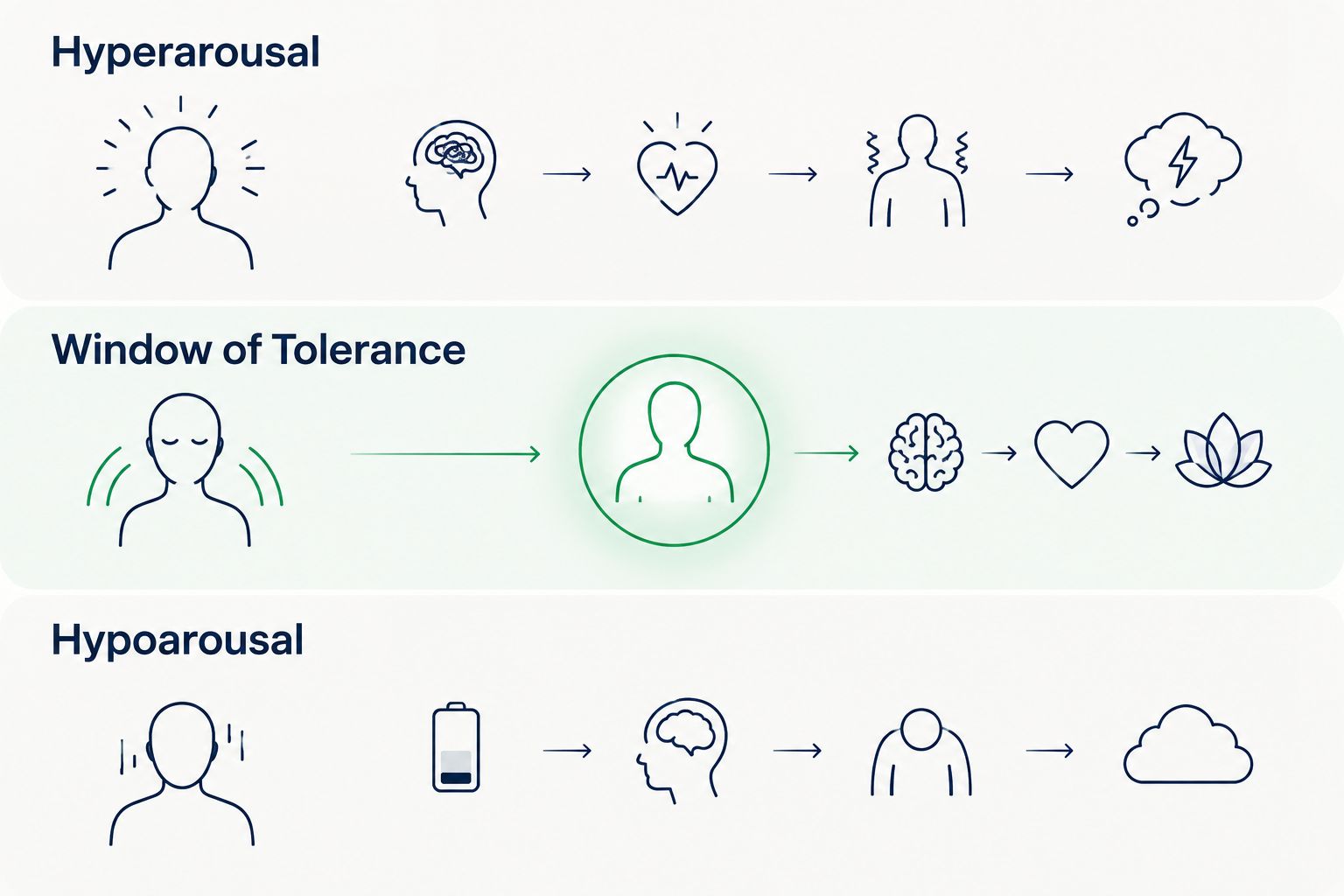
For someone managing PTSD, complex trauma, or OCD, these exercises are maintenance tools between sessions — they support the deeper work of trauma-focused therapy, they don't substitute for it. If flashbacks, panic, or intrusive thoughts are frequent or severe in 2026, a licensed trauma therapist should be part of the plan, not an afterthought.
What makes the best somatic exercise for nervous system regulation
- Keeps you inside the window of tolerance — activating enough to interrupt shutdown, not so activating it retraumatizes
- Backed by polyvagal theory or Somatic Experiencing research, not wellness trend language
- Takes under 5 minutes and needs no equipment or private space in most cases
- Works for acute spikes (panic, flashbacks) as well as daily maintenance
- Can be self-administered without a clinician in the room
- Complements trauma-focused treatment like EMDR instead of competing with it
Somatic exercises at a glance
| Exercise | Best for | Standout feature | Key limitation |
|---|---|---|---|
| Orienting | First 60 seconds after a trigger | Uses eye movement to signal safety to the brain | Doesn't address stored trauma on its own |
| 5-4-3-2-1 grounding | Dissociation and flashbacks | Forces present-moment sensory input | Can feel mechanical under high activation |
| Extended-exhale (Voo) breathing | Racing heart rate, panic spikes | Lengthens the exhale to engage the vagus nerve | Hard to do mid-panic without prior practice |
| Butterfly hug / bilateral tapping | Self-soothing between EMDR sessions | Bilateral stimulation without a therapist present | Not a substitute for full EMDR reprocessing |
| Somatic tracking / body scan | Building daily interoceptive awareness | Trains you to notice sensation before it floods | Slow to show results, needs daily repetition |
| Pendulation | Titrating overwhelming trauma activation | Moves attention between distress and a resourced sensation | Best learned with a somatic therapist first |
| Shaking / TRE-style discharge | Releasing stored tension after activation | Physically discharges survival-stress energy | Can feel awkward, needs privacy |
1. Orienting: best somatic exercise for the first 60 seconds after a trigger
Orienting means slowly turning your head and eyes to scan the room, naming what you see, and letting your gaze land on something neutral. It's one of the oldest tools in somatic work because it uses the eyes — not the thinking brain — to tell your nervous system the threat isn't in the room right now.
Orienting pros:
- Works in under 60 seconds
- No equipment, no privacy required
- Doesn't require you to name or process the emotion
Orienting cons:
- Limited effect if activation is already severe
- Doesn't touch the underlying trauma memory
Best for: the immediate moment after a trigger, before anything else. Verdict: try now.
2. 5-4-3-2-1 grounding: best somatic exercise for dissociation and flashbacks
This exercise walks you through naming 5 things you see, 4 you can touch, 3 you hear, 2 you smell, and 1 you taste. It forces sensory input from the present moment, which is exactly what a flashback or dissociative episode strips away. Reference this alongside the grounding techniques for PTSD flashbacks for a fuller flashback-specific toolkit.
5-4-3-2-1 pros:
- Structured enough to follow even when foggy
- No special training needed
- Works in public or private settings
5-4-3-2-1 cons:
- Can feel like a checklist rather than a felt shift
- Some people need a second pass to fully land
Best for: flashbacks and dissociation specifically. Verdict: try now.
3. Extended-exhale (Voo) breathing: best somatic exercise for panic spikes
Making the exhale longer than the inhale — a 4-count in, 8-count out, or a low "voo" sound on the exhale — directly engages the vagus nerve and slows heart rate. This is one of the fastest physiological levers available for an acute panic spike.
Voo breathing pros:
- Directly targets heart rate, the physical driver of panic
- Portable — works anywhere, silently if needed
- Effect is often felt within a few breaths
Voo breathing cons:
- Hard to initiate once panic is already at its peak
- Needs practice in a calm state before it's reliable under stress
Best for: racing heart, chest tightness, early panic signs. Verdict: try now.
4. Butterfly hug / bilateral tapping: best somatic exercise between EMDR sessions
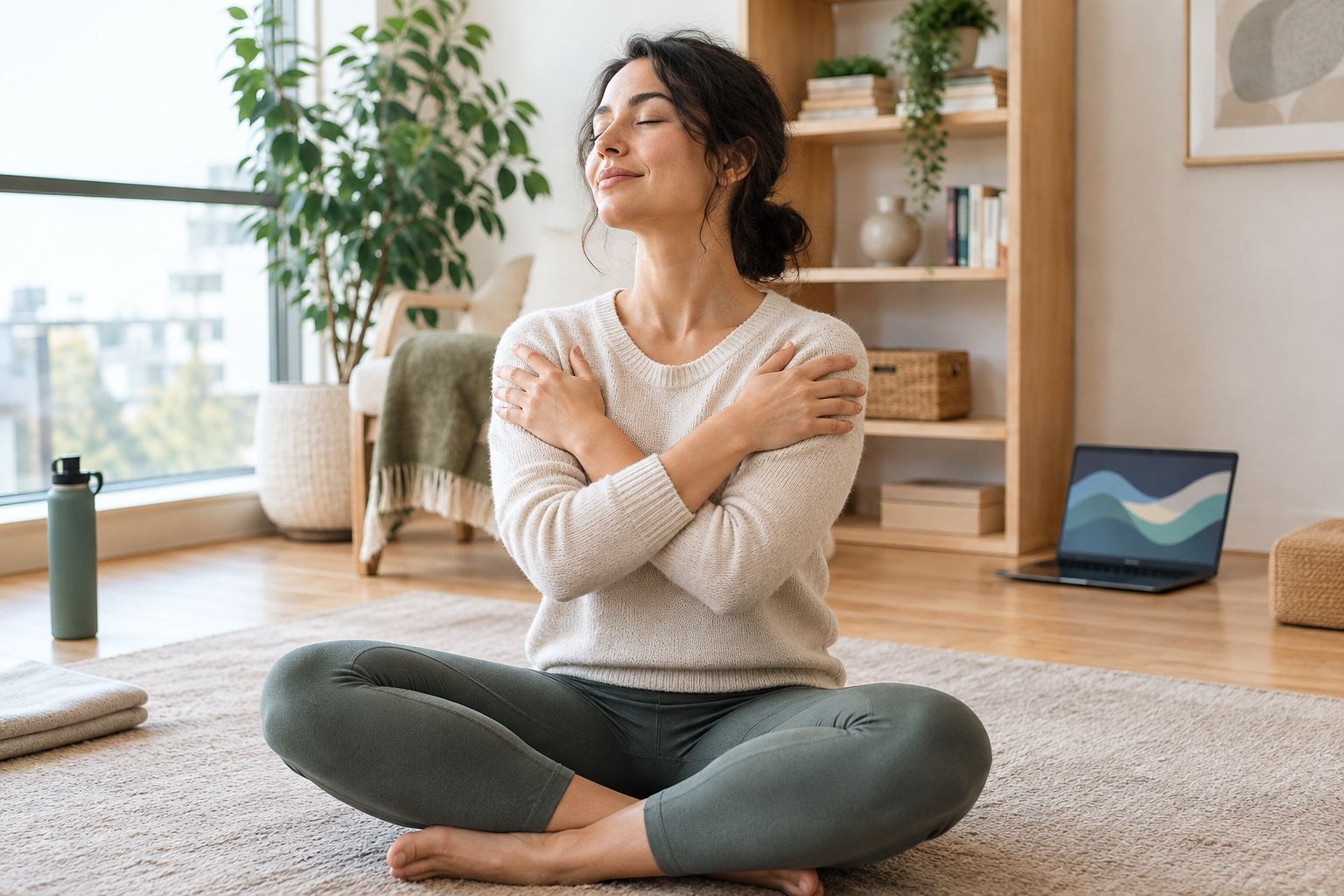
Crossing your arms over your chest and alternately tapping each shoulder mimics the bilateral stimulation used in EMDR sessions. It's widely used as a self-soothing bridge for clients doing EMDR work, including somatic EMDR between scheduled sessions.
Butterfly hug pros:
- Portable, discreet, needs no equipment
- Directly connects to skills already used in EMDR sessions
- Can be paired with a calm memory or phrase
Butterfly hug cons:
- Not a substitute for full EMDR reprocessing
- Some people find crossed-arm tapping uncomfortable at first
Best for: self-soothing between EMDR appointments. Verdict: try now.
5. Somatic tracking / body scan: best for building daily interoceptive awareness
Somatic tracking means slowly scanning attention through the body, noticing sensation without trying to change it — tightness in the jaw, a knot in the stomach, warmth in the hands. Over weeks, this builds interoceptive awareness, the skill of catching activation before it becomes a flood.
Somatic tracking pros:
- Builds a long-term skill, not just a quick fix
- Works well as a daily practice, morning or night
- No equipment or app required
Somatic tracking cons:
- Slow to show results — days to weeks, not minutes
- Can surface uncomfortable sensations before it gets easier
Best for: people building daily regulation capacity rather than managing an acute spike. Verdict: try now.
6. Pendulation: best for titrating overwhelming trauma activation
Pendulation, a core technique from Somatic Experiencing, means deliberately moving attention back and forth between a distressing sensation and a resourced, neutral, or pleasant one. It teaches the nervous system it can touch distress and return to safety, rather than getting stuck in it.
Pendulation pros:
- Directly trains the body's capacity to self-regulate under load
- Backed by Somatic Experiencing research
- Useful for complex trauma work specifically
Pendulation cons:
- Easy to get the titration wrong without training
- Better learned first with a somatic-informed therapist
Best for: complex trauma processing, ideally with clinical support. Verdict: use with guidance.
7. Shaking / TRE-style discharge: best for releasing stored tension after activation
Deliberate shaking of the arms, legs, or whole body — sometimes called tension and trauma release exercises — mimics the natural discharge animals use after a stress response. It physically works survival-stress energy out of the muscles instead of letting it settle in.
Shaking pros:
- Physically discharges stored tension rather than just managing it mentally
- Doesn't require verbal processing
- Can be done in a few minutes
Shaking cons:
- Can feel awkward or exposed in shared spaces
- Not well suited to acute panic — better as an after-the-fact release
Best for: discharging tension after a stressful event has already passed. Verdict: approach with caution.
How this ranking works
Each exercise above is ranked by a single question: does it keep you inside the window of tolerance while addressing a specific, distinct use case? Orienting and 5-4-3-2-1 grounding rank highest for immediate, in-the-moment control. Pendulation and shaking rank lower on ease-of-use because they carry more benefit and more risk of getting the dose wrong without guidance.
Which somatic exercise should you choose in 2026?
If you only build one habit in 2026, make it orienting — it costs nothing, takes under 60 seconds, and works as a first response to almost any trigger. Add 5-4-3-2-1 grounding for flashbacks and Voo breathing for panic spikes, and you have a functional toolkit for the majority of everyday activation.
Pendulation and TRE-style shaking carry real benefit for complex trauma and PTSD, but they work best paired with a licensed trauma therapist rather than attempted alone. Somatic EMDR sessions and intensives are built around exactly this kind of body-based processing for adults dealing with PTSD, complex trauma, anxiety, OCD, and relationship issues across Escondido and San Diego County.
Talk to a somatic trauma therapist
Weekly sessions and intensives for PTSD, complex trauma, anxiety, and OCD in San Diego County.
FAQ
What is the best somatic exercise for nervous system regulation?
Orienting is the best overall somatic exercise for nervous system regulation in 2026 because it works in under 60 seconds without equipment or privacy. For flashbacks specifically, 5-4-3-2-1 grounding tends to work better.
Can somatic exercises replace trauma therapy?
No. Somatic exercises like orienting and the butterfly hug regulate the nervous system in the moment, but they don't process the trauma memory itself. Trauma-focused approaches like Somatic EMDR are built specifically to do that deeper work.
How long does it take to feel a nervous system reset from a somatic exercise?
Orienting and Voo breathing can produce a noticeable shift within seconds to a few minutes. Somatic tracking and pendulation build capacity over days to weeks rather than producing an instant reset.
Is the butterfly hug the same as EMDR?
No. The butterfly hug mimics the bilateral stimulation used in EMDR sessions, but it's a self-soothing tool between sessions, not a replacement for full EMDR reprocessing with a licensed clinician.
What's the difference between grounding and pendulation?
Grounding techniques like 5-4-3-2-1 pull attention into the present moment through the senses. Pendulation, from Somatic Experiencing, deliberately moves attention between distress and a resourced sensation to build tolerance for activation.
Are somatic exercises safe to do alone for complex trauma?
Lighter techniques like orienting and grounding are generally safe alone. Pendulation and TRE-style shaking carry more benefit but also more risk of dysregulation without guidance, and are best learned with a trauma therapist first.
Do somatic exercises help with OCD?
Somatic exercises can lower general arousal, but OCD intrusive thoughts typically need exposure and response prevention (ERP) alongside body-based work rather than regulation exercises alone.
One last thing
The exercise that gets skipped most often is also the simplest: orienting takes under 60 seconds and needs nothing but your eyes, yet most people reach for a breathing technique first and wonder why it doesn't land fast enough — sequence matters as much as the technique itself in 2026 trauma-informed practice.