
Intrusive thoughts don't mean you're dangerous, and reacting to them the wrong way is what keeps OCD running the show. This guide ranks the coping strategies with the strongest track record for reducing intrusive-thought distress in 2026, from Exposure and Response Prevention to somatic grounding, and tells you which one to reach for first.
- Exposure and Response Prevention (ERP) ranks as the best overall strategy among coping strategies for OCD intrusive thoughts in 2026.
- Somatic tracking and grounding work best for calming an active anxiety spike within minutes, not hours.
- ACT-based defusion helps you observe intrusive thoughts without acting on them or seeking reassurance.
- Mindfulness noting supports daily maintenance between therapy sessions, not acute crisis moments.
- EMDR combined with somatic therapy is the strongest adjunct when OCD is tied to earlier trauma.
Why this matters
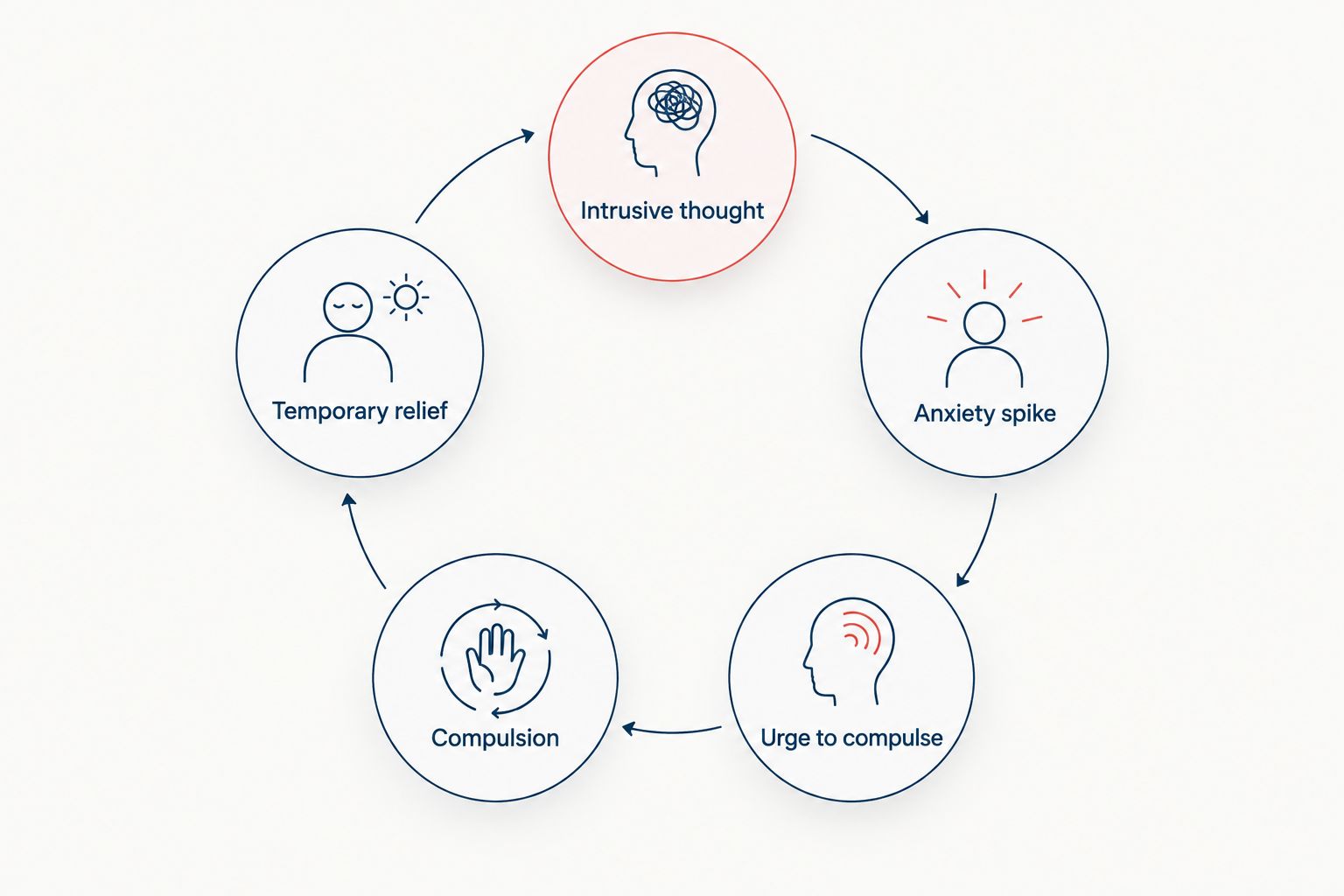
OCD intrusive thoughts aren't rare, and the compulsion that follows one isn't always visible — it can be a mental ritual, a reassurance-seeking text, or an hour of silent reviewing before bed. Generic anxiety advice fails here because it treats the thought, not the cycle the thought triggers. Practices familiar with OCD, including EMDR with Kelli, see this most often as someone who looks composed at work while running mental checklists nonstop, which is part of why intrusive thoughts can quietly affect job performance long before anyone else notices a problem.
The five strategies ranked below intervene at different points in that cycle: some interrupt the compulsion itself, some calm the nervous system before you act on urgency, and one changes your relationship to the thought altogether.
What makes the best coping strategy for OCD intrusive thoughts
- Evidence-based for OCD specifically, not repurposed general-anxiety advice
- Interrupts the compulsion cycle instead of feeding reassurance-seeking
- Practicable independently, between sessions, without a therapist present
- Scales from a mild intrusive thought to a full flare-up
- Works with the body's stress response, not just the thought's content
- Fits into an existing OCD treatment plan rather than replacing it
At a glance: ranking the top coping strategies
| Strategy | Best for | Standout feature | Key limitation |
|---|---|---|---|
| ERP | Breaking the compulsion cycle | Directly targets the OCD mechanism | Distressing before it gets easier |
| Somatic tracking and grounding | Calming an active spike | Works in minutes, no ritual needed | Doesn't resolve the underlying cycle alone |
| ACT / cognitive defusion | Accepting thoughts without acting | Reduces thought-action fusion | Takes practice to stop analyzing thoughts |
| Mindfulness-based noting | Daily maintenance | Low effort, fits into routine | Too subtle for an acute spike |
| EMDR + somatic therapy | Trauma-linked or treatment-resistant OCD | Processes the trauma feeding the obsession | Requires a specialized, trained therapist |
1. Exposure and Response Prevention (ERP): best for breaking the compulsion cycle
ERP asks you to sit with the intrusive thought and the anxiety it triggers without performing the compulsion or mental ritual that usually follows. Over repeated exposures, the nervous system learns the anxiety spike passes on its own without the ritual — a process clinicians call habituation. It's the treatment most guidelines list first for OCD because it works on the exact mechanism that keeps intrusive thoughts sticky: the relief the compulsion provides.
ERP pros:
- Targets the actual OCD cycle, not just surface anxiety
- Used as first-line OCD treatment for decades
- Skills generalize to new intrusive-thought themes over time
ERP cons:
- Distressing in early sessions before habituation sets in
- Needs a trained clinician to build the exposure hierarchy correctly
- Slower relief than a grounding technique in an acute moment
Best for: People whose intrusive thoughts drive a repeated ritual, checking behavior, or reassurance-seeking pattern. Verdict: Build the treatment plan around ERP — don't rely on it alone in the first weeks.
2. Somatic tracking and grounding: best for calming an active anxiety spike
Somatic tracking means noticing where anxiety shows up in the body — tight chest, shallow breath, clenched jaw — and staying with the physical sensation instead of the thought's content until it settles. It works because an intrusive thought loses urgency once the body's alarm response comes down, which usually takes minutes, not hours. The same grounding techniques used for PTSD flashbacks apply directly to an OCD spike, since both are nervous system responses before they're thought problems.

Somatic tracking pros:
- Works within minutes during an active spike
- No therapist needed once the technique is learned
- Reduces the physical urgency that drives compulsions
Somatic tracking cons:
- Doesn't address the underlying compulsion cycle on its own
- Can feel like "doing nothing" at first, which some people resist
Best for: Moments when an intrusive thought has already triggered a full anxiety spike and you need it to pass before deciding how to respond. Verdict: Use as the bridge strategy alongside ERP, not as a stand-alone fix.
3. ACT / cognitive defusion: best for accepting intrusive thoughts without acting on them
Acceptance and Commitment Therapy treats the thought itself as background noise rather than a command. Defusion techniques — labeling a thought as "I'm noticing the thought that..." instead of engaging with its content — loosen the fusion between having a thought and believing you must respond to it. This matters for OCD because the compulsion is often less about the thought and more about the belief that thinking it means something.
ACT pros:
- Reduces thought-action fusion, a core driver of OCD distress
- Portable — usable anywhere, no equipment or privacy needed
- Complements ERP by reducing the meaning attached to the thought
ACT cons:
- Takes practice before defusion feels natural instead of forced
- Less structured than ERP for someone who needs a clear hierarchy
Best for: People stuck analyzing what an intrusive thought "means" about them rather than performing a visible ritual. Verdict: Add once acute spikes are less frequent; it's a maintenance skill, not a crisis tool.
4. Mindfulness-based noting: best for daily maintenance between sessions
Noting is a simplified mindfulness practice: name the thought category ("planning," "worrying," "checking") as it arises and let it pass without following the thread. It's lower-effort than ERP or ACT and works as a daily habit rather than a response to a single spike. Over time, noting builds the same distance from thoughts that defusion aims for, just with less structure.
Mindfulness noting pros:
- Low effort, easy to build into a daily routine
- Reduces the meta-anxiety of worrying about having intrusive thoughts
- Requires no special training to start
Mindfulness noting cons:
- Too subtle to interrupt a full compulsion urge on its own
- Benefits build slowly, over weeks of consistent practice
Best for: Ongoing maintenance for someone whose OCD is already partly managed through ERP. Verdict: Keep as a daily practice; don't expect it to handle an acute flare-up alone.
5. EMDR combined with somatic therapy: best for trauma-linked or treatment-resistant OCD
When OCD intrusive thoughts trace back to an earlier trauma, or ERP alone hasn't resolved the distress, combining EMDR with somatic tracking can process the material feeding the obsession rather than only managing the compulsion around it. This is an adjunct approach, layered onto ERP-informed work, not a replacement for it. Kelli Lane Redfield, LMFT, the founder of EMDR with Kelli, works this way — using EMDR techniques for complex trauma alongside somatic tracking for clients in Escondido and San Diego County whose OCD is tangled up with unresolved trauma.
EMDR + somatic pros:
- Addresses trauma underneath the obsession, not just its surface pattern
- Combines body-based regulation with structured reprocessing
- Useful when standard ERP has plateaued
EMDR + somatic cons:
- Requires a clinician specifically trained in both modalities
- Not typically a first step for uncomplicated OCD without a trauma history
Best for: OCD that developed alongside, or worsened after, a distinct traumatic event. Verdict: Layer onto ERP when trauma is clearly part of the picture — skip it as a starting point otherwise.
Talk Through Your OCD Pattern
Somatic EMDR intensives and weekly sessions in Escondido and San Diego County.
How this list was ranked
Each strategy was weighed against the criteria above: whether it targets the compulsion cycle or just the surface anxiety, whether it can be practiced independently, and whether it scales from a mild intrusive thought to a full flare-up. ERP ranks first because it's the only one on this list built specifically to break the reinforcement loop between thought and compulsion; the rest earn their place by covering what ERP doesn't do well on its own — immediate regulation, daily maintenance, or trauma processing.
Which coping strategy should you use?
If you only start with one, start with ERP guided by a licensed clinician, and use somatic grounding as the bridge you lean on between sessions. Add ACT defusion once acute spikes are less frequent, and bring EMDR into the plan if your intrusive thoughts trace back to an earlier trauma that hasn't resolved. None of these replace an evaluation from a licensed therapist — OCD presentations vary enough in 2026's clinical practice that the right combination depends on your specific pattern of thoughts and compulsions.
FAQ
What's the best coping strategy for OCD intrusive thoughts?
Exposure and Response Prevention (ERP) is the coping strategy most consistently used as first-line treatment for OCD intrusive thoughts. It works by removing the compulsion that normally follows the thought, which breaks the cycle that keeps the thought sticky.
Is ERP better than mindfulness for OCD?
ERP and mindfulness serve different jobs rather than competing directly. ERP interrupts the compulsion cycle itself, while mindfulness-based noting helps you tolerate day-to-day intrusive thoughts once the acute cycle is already less intense.
Can grounding techniques stop an OCD spiral?
Grounding and somatic tracking can calm the physical anxiety spike that drives an OCD spiral within minutes. They don't resolve the underlying compulsion cycle on their own, so they work best alongside ERP rather than instead of it.
Does having intrusive thoughts mean something is wrong with me?
No. Unwanted intrusive thoughts are common across the general population, not just among people with OCD. What defines OCD is the compulsive response to the thought, not the thought's content.
Can EMDR help with OCD?
EMDR is used alongside ERP-informed strategies when OCD intrusive thoughts are tied to earlier trauma or haven't fully resolved with ERP alone. It's typically an adjunct to established OCD treatment, not a stand-alone replacement for it.
How is somatic EMDR different from standard EMDR for OCD-related trauma?
Somatic EMDR adds body-based tracking of physical sensations to the standard EMDR reprocessing protocol. This can help when trauma shows up as physical tension or a stuck stress response rather than only as a mental image.
When should I see a therapist for OCD intrusive thoughts?
See a licensed therapist when intrusive thoughts start driving rituals, checking, or reassurance-seeking that take up real time in your day, or when the thoughts affect your work or relationships. A clinician can confirm whether ERP, EMDR, or a combination fits your specific pattern.
One last thing
Published research on intrusive thoughts has found that the large majority of people, not just those with OCD, experience unwanted violent, sexual, or blasphemous thoughts at some point. The thought itself isn't diagnostic — the compulsive response to it is what separates an intrusive thought from OCD, and that distinction is exactly why coping strategies for OCD intrusive thoughts target the response, not the thought's content. That's also why a strategy that only tries to stop the thought from occurring will keep failing in 2026 the same way it failed a decade ago: the goal was never a thought-free mind, it was an unhooked response.