
Best overall: grounding and safety prompts. Best for reconnecting with the body: somatic body-tracking prompts. Best for shame and self-blame: self-compassion and reframing prompts. Best for a fragmented trauma story: narrative processing prompts — and none of these replace working with a licensed trauma therapist.
- Grounding and safety prompts rank first among the best journaling prompts for trauma recovery in 2026 because stabilization comes before narrative processing.
- Somatic body-tracking prompts are the pick for reconnecting with physical sensation between EMDR or somatic therapy sessions.
- Narrative processing prompts organize a fragmented trauma story but carry the highest risk of overwhelm if used too early.
- Self-compassion prompts target shame and self-blame; relationship prompts target attachment and boundary patterns.
- Journaling supplements trauma treatment — it does not substitute for care from a licensed clinician.
Why this matters
Journaling is one of the few trauma-recovery tools a person can use alone, on their own schedule, for free. That also makes it easy to use wrong — writing straight into a traumatic memory before the nervous system feels safe on the page can spike distress instead of lowering it.
The ranking below follows the same phase-based logic used in trauma treatment generally: safety and stabilization first, then processing, then reconnection. EMDR with Kelli works with adults in Escondido and San Diego County using Somatic EMDR intensives and weekly sessions, and the categories below are ordered the way a trauma-informed clinician would sequence them, not by how satisfying they are to write.
One caution worth stating plainly in 2026: if a prompt triggers a flashback, dissociation, or a spike in panic, stop writing and use a grounding skill before continuing. That is not a failure of the prompt — it is information about pacing.
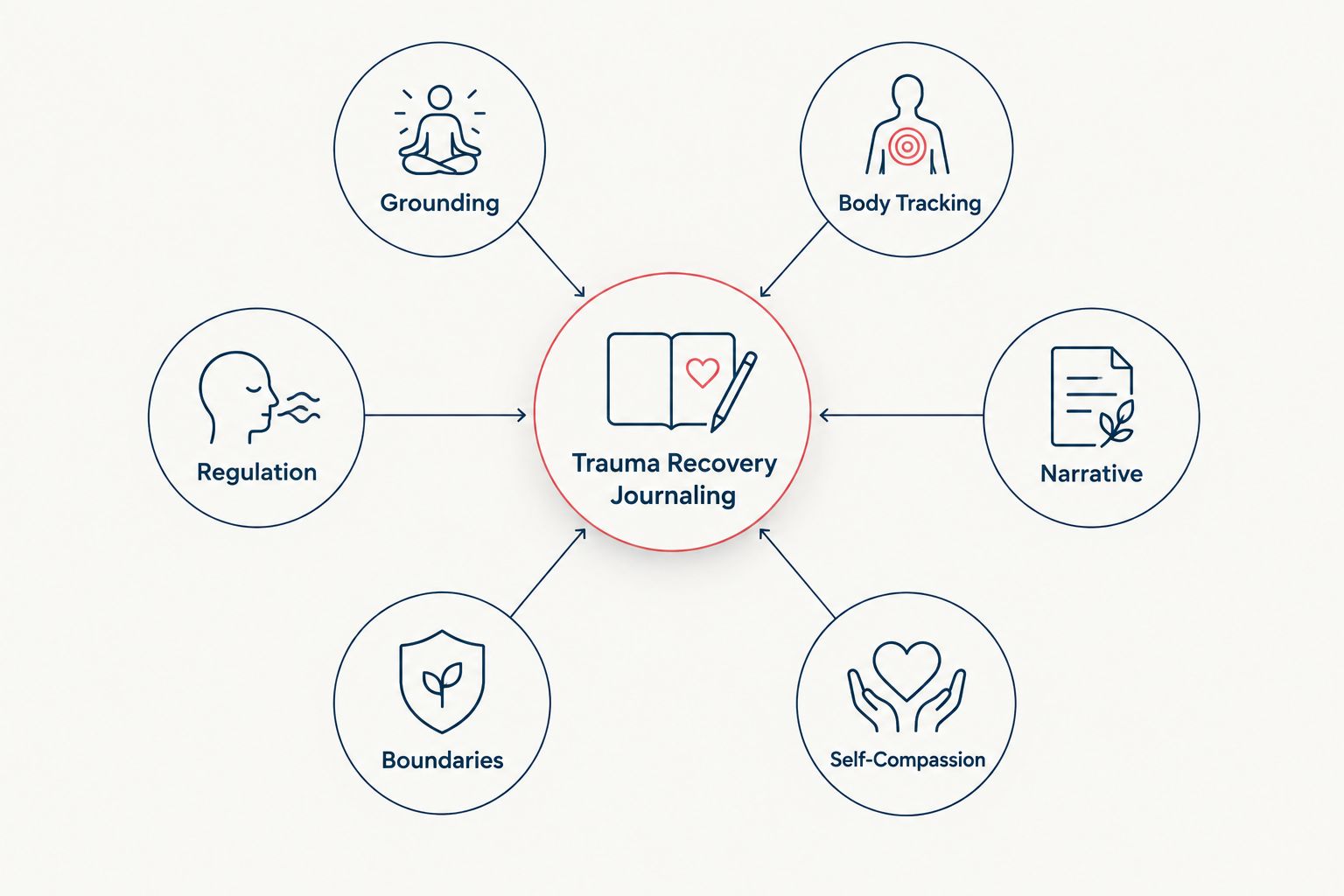
What makes the best journaling prompts for trauma recovery
- Matches the treatment phase. Safety and stabilization prompts come before deep narrative work, not after.
- Nervous system safety. A good prompt gives an exit ramp — it never demands you stay in a memory longer than feels tolerable.
- Concreteness. The strongest prompts can be answered in 10-15 minutes with specific sensory or behavioral detail, not vague reflection.
- Body-based, not just narrative. Prompts that ask about physical sensation do more for regulation than prompts that only ask about the story.
- Compatible with active treatment. Prompts that support EMDR or somatic work between sessions outperform generic "write about your feelings" prompts.
- Evidence basis. Expressive writing research, dating back to psychologist James Pennebaker's work in the 1980s, links structured writing about difficult experiences to measurable drops in physiological stress markers — but that research studied writing about the experience, not reliving it.
Journaling prompt categories at a glance
| Category | Best for | Standout feature | Key limitation |
|---|---|---|---|
| Grounding & safety prompts | Acute distress, flashbacks | Keeps writing in the present tense and body | Doesn't process the trauma itself |
| Body-tracking (somatic) prompts | Reconnecting with sensation | Bridges journaling and somatic therapy | Requires some body-awareness skill first |
| Narrative processing prompts | Organizing a fragmented story | Builds a coherent timeline | Can overwhelm if used before stabilization |
| Self-compassion & reframing prompts | Shame, guilt, self-blame | Targets the inner critic directly | Can feel hollow without prior stabilization |
| Relationship & boundary prompts | Relational or attachment trauma | Names patterns across relationships | Needs specific, not generic, prompts |
| Nervous system regulation prompts | Daily use between sessions | Low intensity, sustainable habit | Doesn't address the trauma content |
1. Grounding & Safety Prompts: best journaling prompts for trauma recovery during flashbacks
Grounding prompts anchor you in the present moment using the five senses and simple facts about right now — today's date, the room you're in, what you can hear. They exist to lower activation, not to explore the trauma.
For readers who arrived here searching best journaling prompts for trauma recovery after a rough day, this is the starting category, not narrative work. Pair it with a grounding techniques for PTSD flashbacks practice for the moments writing alone isn't enough.
Grounding prompts pros:
- Fast to complete — usually under 5 minutes
- Lowers activation instead of raising it
- Safe for people newly out of crisis or in early stabilization
Grounding prompts cons:
- Doesn't move the trauma toward resolution on its own
- Can feel repetitive if used as the only tool for months
Best for: flashbacks, panic spikes, and the first weeks after a destabilizing event. Verdict: start here.
2. Body-Tracking (Somatic) Prompts: best journaling prompts for trauma recovery to reconnect with sensation
Somatic prompts ask you to notice and describe physical sensation — tightness, temperature, tingling — without immediately attaching a story to it. This is the written companion to somatic tracking used in Somatic EMDR sessions.
These prompts work well alongside somatic therapy exercises for anxiety relief because both are training the same skill: noticing the body before reacting to it.

Body-tracking prompts pros:
- Builds interoceptive awareness — the skill of noticing internal states
- Complements somatic and EMDR work directly
- Works as a short daily practice, not just a crisis tool
Body-tracking prompts cons:
- Harder for people who are newly disconnected from body sensation
- Less useful if the goal is organizing a chronological story
Best for: clients actively doing somatic or EMDR work who want a between-session practice. Verdict: use alongside active treatment.
3. Narrative Processing Prompts: best journaling prompts for trauma recovery for a fragmented story
Narrative prompts ask you to build a timeline — what happened before, during, and after — in order to make an event feel more organized in memory. This is the category most people picture when they think of "trauma journaling."
The risk is real: writing a full narrative before the nervous system has stabilization skills can retraumatize rather than resolve. EMDR techniques for complex trauma exist precisely because unassisted narrative processing of complex trauma often needs a trained clinician in the room.
Narrative processing prompts pros:
- Builds coherence out of fragmented or nonlinear memory
- Can reduce intrusive replay when paced correctly
- Gives language to events that were never verbalized
Narrative processing prompts cons:
- Highest overwhelm risk of any category on this list
- Not recommended as a first step for complex or unresolved PTSD without clinical support
Best for: people already in treatment who want to organize memory between sessions, with a therapist's guidance. Verdict: use with caution, ideally alongside a clinician.
4. Self-Compassion & Reframing Prompts: best journaling prompts for trauma recovery for shame and self-blame
These prompts target the inner critic directly — questions like "what would I say to a friend in this situation" or "what did I actually have control over." Shame and self-blame are common after trauma, especially relational or childhood trauma, and they respond differently than fear does.
Self-compassion prompts pros:
- Directly addresses shame, which grounding and narrative prompts often miss
- Low risk of activation compared to narrative work
- Pairs well with reframing skills taught in therapy
Self-compassion prompts cons:
- Can feel hollow or forced without some prior stabilization work
- Not sufficient alone for deeply entrenched shame patterns
Best for: survivors carrying guilt or self-blame, particularly after childhood or relational trauma. Verdict: use regularly, best paired with therapy.
5. Relationship & Boundary Prompts: best journaling prompts for trauma recovery for relational patterns
These prompts ask you to name patterns across relationships — who you go quiet around, whose approval you chase, where a boundary got crossed and what happened after. They're built for attachment and relational trauma specifically, not single-incident trauma.
Relationship prompts pros:
- Surfaces patterns that repeat across multiple relationships
- Useful preparation material for couples or relational therapy work
- Concrete enough to avoid vague "how do you feel about relationships" writing
Relationship prompts cons:
- Generic versions of this prompt type produce generic, unhelpful answers
- Needs specificity — naming an actual person and moment, not a category of people
Best for: relational or attachment trauma, and anyone preparing for couples work. Verdict: use with specific prompts, skip the vague ones.
6. Nervous System Regulation Prompts: best journaling prompts for trauma recovery between sessions
Regulation prompts are the lowest-intensity category — short daily check-ins on sleep, appetite, startle response, and mood that build a pattern over weeks. They don't touch trauma content directly.
Regulation prompts pros:
- Sustainable as a daily habit, unlike narrative work
- Gives you and your therapist real data on regulation trends over time
- Almost zero risk of overwhelm
Regulation prompts cons:
- Doesn't process trauma content on its own
- Can feel too light for someone wanting faster progress
Best for: daily maintenance alongside any active treatment. Verdict: keep it running in the background.
Talk through your pacing with a clinician
Somatic EMDR sessions and intensives are available across Escondido and San Diego County.
How we ranked these
The order above follows the phase-based model used broadly in trauma treatment: safety and stabilization before processing, processing before deep relational or narrative work. Grounding ranks first in 2026 not because it's the most powerful category, but because it's the safest starting point for the widest range of readers, including people in acute distress right now.
Which journaling prompts should you choose in 2026?
If you're not in active treatment and you're searching for the best journaling prompts for trauma recovery because today has been hard: start with grounding and safety prompts. If you're already doing EMDR or somatic therapy, body-tracking and regulation prompts make the strongest between-session companions. Save narrative and deep relational prompts for periods when you have clinical support, not for a hard night alone.
Journaling in 2026 is still a self-help tool, not a treatment. For PTSD, complex trauma, OCD, or relationship patterns that keep repeating, a licensed clinician changes what's possible in a way a notebook can't.
FAQ
What are the best journaling prompts for trauma recovery?
Grounding and safety prompts rank as the best starting point for trauma recovery journaling because they stabilize the nervous system before any narrative work begins. Somatic, self-compassion, and regulation prompts follow depending on what you need that week.
Is journaling safe for someone with PTSD?
Grounding and regulation prompts are generally low-risk for PTSD, but narrative prompts that ask you to fully recount an event can retraumatize without clinical support. Stop writing and use a grounding skill if a prompt spikes distress.
Can journaling replace trauma therapy?
No. Journaling supports awareness and regulation between sessions, but it doesn't provide the trained pacing, reprocessing methods, or nervous system support a licensed trauma therapist offers.
How long should a trauma journaling entry be?
Most effective entries run 10 to 15 minutes, especially for grounding and body-tracking prompts. Longer narrative entries should only happen with clinical support in place.
What if a journaling prompt triggers a flashback?
Stop writing immediately and use a grounding technique before returning to the page, if you return at all that day. This is a normal pacing signal, not a sign journaling failed.
Should I journal before or after an EMDR session?
Body-tracking and regulation prompts work well between sessions to reinforce skills. Save deeper narrative journaling for times when it can be discussed with your therapist.
What's the difference between somatic journaling and regular journaling?
Somatic journaling asks you to describe physical sensation directly, while regular journaling usually centers on thoughts and events. Somatic prompts build body awareness that supports work like Somatic EMDR.
How often should I journal for trauma recovery?
Daily short entries, especially regulation and grounding prompts, tend to build more consistent nervous system awareness than occasional long entries. Consistency matters more than length.
One last thing
The category people skip most often is regulation prompts, because they feel too simple to matter. In practice, a short daily entry on sleep, appetite, and startle response gives you and a treating clinician real pattern data over weeks — data a single dramatic narrative entry never produces.