
Best overall: The Trauma Therapist Podcast. Best for developmental trauma: Transforming Trauma. Best for practical coping skills: Being Well. These are the best podcasts on trauma healing and somatic therapy to consider in 2026 if you want informed conversations without mistaking a recording for treatment.
- The Trauma Therapist Podcast is the best overall pick for conversations about trauma therapy.
- Transforming Trauma is the best podcast on this list for developmental trauma and the nervous system.
- Being Well is the practical pick when you want to reflect on coping skills.
- No podcast provides an individual assessment or replaces trauma therapy.
Why this matters
A podcast can give you language for an experience that has been hard to describe. It cannot tell you whether a particular exercise, memory-processing approach, or diagnosis fits your situation. That distinction matters when a discussion of trauma begins to feel like instructions for your own care.
For adults considering somatic EMDR, EMDR with Kelli is a therapy practice, not a podcast or a substitute for one. Its therapy practice offers Somatic EMDR intensives and weekly sessions in Escondido and San Diego County. Use a podcast to develop questions; use a qualified clinician to decide what belongs in treatment.
What makes the best trauma healing podcast?
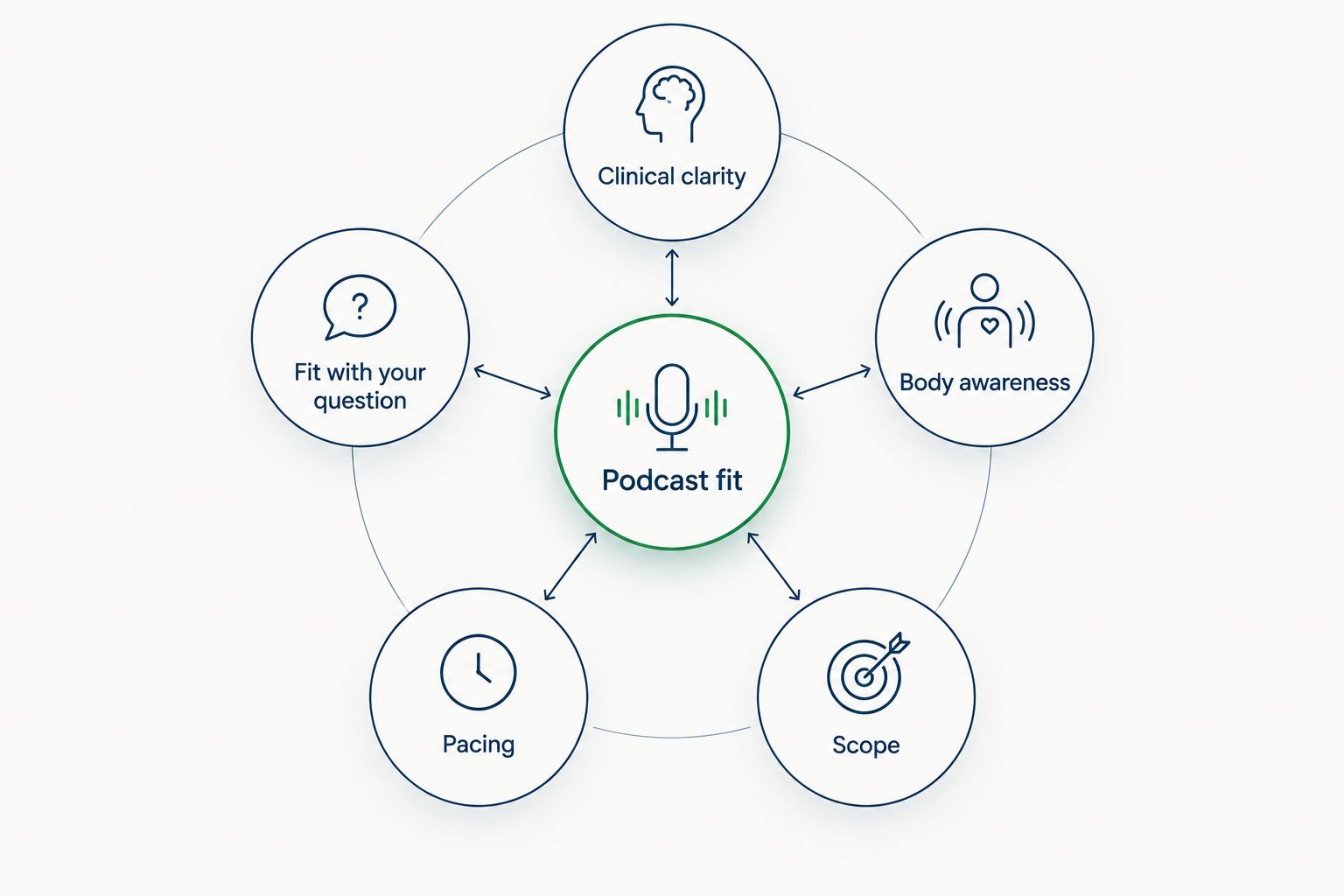
The right show depends on what you can listen to without feeling pushed to process more than you intended. Use these 5 criteria before following a recommendation:
- Clinical clarity: Can you tell when a guest is describing a therapeutic approach rather than giving instructions to every listener?
- Body awareness: Does the conversation leave room for sensations and nervous-system responses without treating every sensation as proof of trauma?
- Scope: Is the show about trauma treatment, a related model, or general wellbeing? Those are different kinds of listening.
- Pacing: Can you pause, skip, or choose a different episode when the subject feels too activating?
- Fit with your question: Are you trying to understand therapy, learn about developmental trauma, explore parts work, or find everyday coping ideas?
The best podcast is not the one that asks you to revisit the most difficult material. It is the one that helps you stay oriented while you learn what to ask next.
Best podcasts on trauma healing and somatic therapy at a glance
| Podcast | Best for | Standout focus | Key limitation |
|---|---|---|---|
| The Trauma Therapist Podcast | Understanding trauma therapy | Conversations with trauma professionals | Professional discussions are not personal guidance |
| Transforming Trauma | Exploring developmental trauma | The NeuroAffective Relational Model, or NARM | Model-specific perspective |
| Therapy Chat | Hearing broader therapy perspectives | Conversations about psychotherapy and trauma | Topics extend beyond somatic work |
| Being Well | Reflecting on everyday coping | Psychology and practical wellbeing topics | Not a trauma-treatment podcast |
| The One Inside | Learning about parts work | Internal Family Systems discussions | IFS is not the same as somatic EMDR |
The table separates the shows by what you need from the listening. None offers a reason to start memory processing on your own. If you want to explore a technique you hear about, bring the question to your therapist rather than treating an episode as a session plan.
1. The Trauma Therapist Podcast: best for understanding trauma therapy
Best for: You want to hear how professionals talk about trauma treatment before deciding what questions to ask a therapist.
The Trauma Therapist Podcast centers conversations with people working in trauma therapy. Its interview format is useful when you want to hear more than one clinical perspective instead of following a single self-help method. The Trauma Therapist Podcast is the best overall choice here for understanding the field of trauma therapy.
The Trauma Therapist Podcast pros:
- Interviews let you hear how practitioners explain their approaches.
- The professional focus helps distinguish treatment models from general wellness advice.
- It gives you terms you can take into a consultation or therapy session.
The Trauma Therapist Podcast cons:
- A clinician speaking to another clinician is not assessing you.
- An episode can introduce a method without telling you whether it fits your history or current stability.
How to listen: Pick a topic that answers a question you already have. If an interview introduces an unfamiliar treatment, note its name and ask what training, goals, and preparation that treatment involves. Do not interpret an account of someone else's progress as a timetable for your own.
Verdict: Buy if your main goal is to understand trauma therapy; hold off on any exercise that calls for personal trauma processing without support.
2. Transforming Trauma: best for developmental trauma
Best for: You want a focused introduction to developmental trauma and the role of relationship and nervous-system responses in healing.
Transforming Trauma discusses trauma through the lens of the NeuroAffective Relational Model, known as NARM. That makes its focus easier to identify than a show that moves between unrelated wellness topics. It is a useful starting point for questions about long-standing patterns rather than a guide to diagnosing them in yourself.
Transforming Trauma pros:
- Its model-specific focus gives discussions a clear clinical frame.
- It keeps developmental trauma in view rather than treating every response as an isolated symptom.
- It offers language for discussing patterns with a therapist.
Transforming Trauma cons:
- NARM is one therapeutic model, not a complete map of every trauma treatment.
- Listening to a discussion of developmental trauma does not establish that the term applies to you.
How to listen: Notice which ideas help you describe a present-day response more accurately. You do not need to trace that response to a particular childhood event while listening. If a topic brings up distress, pause and return your attention to where you are now.
Verdict: Buy for a focused introduction to developmental trauma; do not use it as a self-diagnosis tool.
3. Therapy Chat: best for a range of therapy perspectives
Best for: You are comparing therapy concepts and want conversations that extend beyond a single trauma model.
Therapy Chat covers psychotherapy topics through conversations with clinicians and other guests. The range helps when you are still working out which questions to ask about trauma, attachment, or therapeutic support. It also means you must check each episode's topic rather than assuming every conversation is about somatic therapy.
Therapy Chat pros:
- A broader range of topics can help you identify the question you want answered.
- Conversation is easier to pause and reflect on than a step-by-step exercise.
- Different perspectives give you terms to discuss with your clinician.
Therapy Chat cons:
- The breadth makes it a less direct pick for somatic EMDR.
- A guest's approach can sound applicable even when it does not fit your treatment needs.
How to listen: Start with an episode whose subject matches your immediate question. Separate what a guest says about their approach from what a clinician who knows you has recommended. If the episode raises a question about attachment or trauma, write that question down instead of trying to resolve it all at once.
Verdict: Hold if you need a specifically somatic discussion; choose it when a wider therapy conversation is the point.
4. Being Well: best for practical coping ideas
Best for: You want to reflect on psychology and everyday wellbeing without starting with a discussion of trauma treatment.
Being Well discusses psychological skills and wellbeing in an accessible conversational format. It is the clearest choice on this list when your immediate question is about coping rather than the details of a trauma therapy model. That practical emphasis is also its limit: coping with distress and processing trauma are not the same task.
Being Well pros:
- The topics give you ideas to consider in daily life.
- You can listen for a useful question without adopting an entire treatment model.
- Its general focus offers an alternative when clinical interviews feel too intense.
Being Well cons:
- It is not a substitute for assessment or trauma treatment.
- General advice cannot account for your triggers, symptoms, or treatment plan.
How to listen: Treat a coping idea as something to discuss or consider, not as a test you have to pass. If an idea makes you more distressed, stopping is a reasonable response. You can bring that reaction to therapy; you do not have to force the exercise to work.
Verdict: Buy for reflection on coping; skip it if you need a detailed explanation of somatic EMDR.
5. The One Inside: best for learning about parts work
Best for: You are curious about Internal Family Systems, or IFS, and how people talk about inner parts.
The One Inside focuses on IFS conversations. Parts language can give some listeners a way to describe conflicting feelings without reducing them to a single label. IFS and somatic EMDR are distinct approaches, so choose this show for its own subject rather than expecting an EMDR explanation.
The One Inside pros:
- The subject is clear if IFS is the approach you want to understand.
- Parts language can help you frame questions about conflicting responses.
- It adds a different perspective to a trauma-podcast shortlist.
The One Inside cons:
- Its IFS focus does not make it a guide to EMDR treatment.
- An explanation of parts work is not an individual assessment or therapy session.
How to listen: Learn the vocabulary without feeling obliged to assign a part to every thought or sensation. If the approach interests you, ask a clinician how IFS differs from the treatment you currently receive or are considering.
Verdict: Hold if your question is specifically about somatic EMDR; buy for an introduction to IFS language.
How these podcasts were ranked
This is a 2026 reading guide, not a clinical effectiveness ranking. The order follows the criteria above: clarity about the show's subject, relevance to trauma or body-focused questions, usefulness for a defined listener, and the ease of keeping podcast information separate from personal treatment advice. An interview show leads because it is the broadest match for someone trying to understand trauma therapy; the more specialized or general shows follow for different questions.
No rank tells you which therapy to choose. Podcast discussions do not assess dissociation, safety, symptom severity, or whether you are ready for trauma memory work. Those decisions belong in individual care with a qualified professional.
Which trauma healing podcast should you choose?
Choose The Trauma Therapist Podcast if you are undecided. It is the strongest first stop for understanding how trauma professionals describe their work. Choose Transforming Trauma when your question is specifically about developmental trauma; choose Being Well when you want to think about coping rather than treatment models.
For an EMDR question, a podcast can help you formulate what to ask, but it cannot determine your treatment plan. EMDR with Kelli offers Somatic EMDR for adults through weekly sessions and intensives; whether that approach fits you calls for an individual conversation, not an episode recommendation. In 2026, keep that boundary clear even when a podcast feels personally relevant.
FAQ
What is the best podcast on trauma healing and somatic therapy?
The Trauma Therapist Podcast is the best overall starting point on this list for understanding trauma therapy. If your question is specifically about developmental trauma, start with Transforming Trauma instead.
Which podcast is best for learning about developmental trauma?
Transforming Trauma is the focused pick for developmental trauma. Its NARM perspective is a way to learn about one model, not a way to diagnose yourself.
Can a trauma podcast replace therapy?
No. A podcast cannot assess your symptoms, plan treatment, or respond to your needs as they change. Use what you hear to form questions for a qualified clinician.
Is parts work the same as somatic EMDR?
No. Parts work discussed through IFS and somatic EMDR are distinct therapeutic approaches. The One Inside is a better pick for IFS language than for an explanation of EMDR.
Should I listen to trauma podcasts if they bring up difficult memories?
Pause or stop if listening brings up distress that feels hard to manage. Orient to your present surroundings and discuss the reaction with a clinician rather than pushing through the episode.
Which podcast should I choose for coping ideas rather than trauma processing?
Being Well is the pick for reflecting on everyday coping ideas. Its general wellbeing focus does not make it an individual trauma-treatment plan.
How do I use a podcast while considering somatic EMDR?
Use a podcast to identify questions about preparation, body awareness, and treatment goals. Discuss those questions with a qualified clinician before trying to process traumatic memories.
One last thing
You can stop an episode halfway through and still have learned something useful. In 2026, choose a single question to take from your listening: What approach is being discussed, and how would a clinician decide whether it fits me? That question does more for your care than finishing material that leaves your nervous system overwhelmed.
EMDR with Kelli provides Somatic EMDR therapy, not a podcast-based treatment plan. If listening has clarified that you want personal support, use the questions you gathered to discuss what treatment would involve. The best podcast gives you language; a therapeutic relationship gives that language context.