
Best overall: orienting to the room. Best for a racing mind: gentle exhale-focused breathing. Best for physical tension: supported movement. Best for an unsustainable care load: a specific handoff request. Best for persistent trauma-related distress: therapist-guided Somatic EMDR. These are the best self-regulation tools for caregiver burnout in 2026 because each addresses a different part of the problem; none replaces adequate help with caregiving.
- For caregiver burnout, start with orienting when you need to reconnect with your surroundings without forcing calm.
- Use gentle breathing for racing thoughts and supported movement when tension makes sitting still difficult.
- A specific handoff request addresses the care load; self-regulation alone cannot redistribute it.
- EMDR with Kelli offers therapist-guided Somatic EMDR for adults when trauma-related distress needs clinical attention.
Why this matters
Caregiving can keep your attention on someone else's needs long after your own body signals fatigue, tension, or alarm. In 2026, a useful regulation tool still has to fit the moment you are in: you may have a quiet minute, or you may need to stay alert while another person depends on you.
Self-regulation means noticing what is happening in your nervous system and choosing a response that helps you stay present. It does not mean making a heavy workload feel acceptable. If you want more body-based options, the somatic exercises for nervous system regulation guide explains ways to notice and respond to physical cues. The starting point here is simpler: match the tool to the signal you notice.
If your distress feels connected to trauma, panic, or intrusive thoughts, a self-help exercise is not a substitute for an individual clinical assessment. The same applies when exhaustion is affecting your ability to care for yourself or another person. Choose a tool for the immediate moment, then address the support or treatment need separately.
What makes the best self-regulation tool for caregiver burnout?
Use these criteria before choosing an exercise. The best tool is the one you can use safely without abandoning the person in your care or ignoring the cause of your strain.
- Fits your setting: You can use it while seated, standing nearby, or taking an appropriate break. A method that requires privacy will not fit every caregiving moment.
- Matches the signal: Racing thoughts, muscle tension, and a sense of disconnection call for different responses. Start with what you actually notice, not the exercise you think you should prefer.
- Allows choice: You can stop, adjust, or switch methods. No regulation exercise should require you to push through increased distress.
- Keeps attention available: If you need to monitor someone, choose an option that lets you stay aware of your surroundings.
- Addresses the care load: A brief exercise can help you respond to stress. It cannot provide rest, backup care, or a workable division of responsibilities.
- Respects clinical needs: Persistent trauma symptoms and severe distress deserve more than a list of exercises. Professional support belongs in the decision, not as a last-minute footnote.
At a glance: which option fits your moment?
| Tool | Best for | Standout feature | Key limitation |
|---|---|---|---|
| Orienting to the room | Feeling disconnected or overwhelmed | Keeps attention on the present setting | Can feel uncomfortable when surroundings do not feel safe |
| Gentle exhale-focused breathing | Racing thoughts with room to pause | Requires no equipment | Breath focus can increase distress for some people |
| Supported movement | Physical tension or restlessness | Works without sitting still | May not fit mobility needs or a care task underway |
| A specific handoff request | Too many tasks resting on you | Changes the immediate division of work | Depends on another person's availability |
| Therapist-guided Somatic EMDR | Trauma-related distress that persists | Makes room for individual assessment and treatment | Is not an on-demand exercise for an urgent moment |
The table is a decision aid, not a treatment plan. In 2026, start with the row that describes your current experience; if no row fits, pause rather than force an exercise. You can combine options later, but first check whether you need a moment of regulation, practical relief, or clinical care.
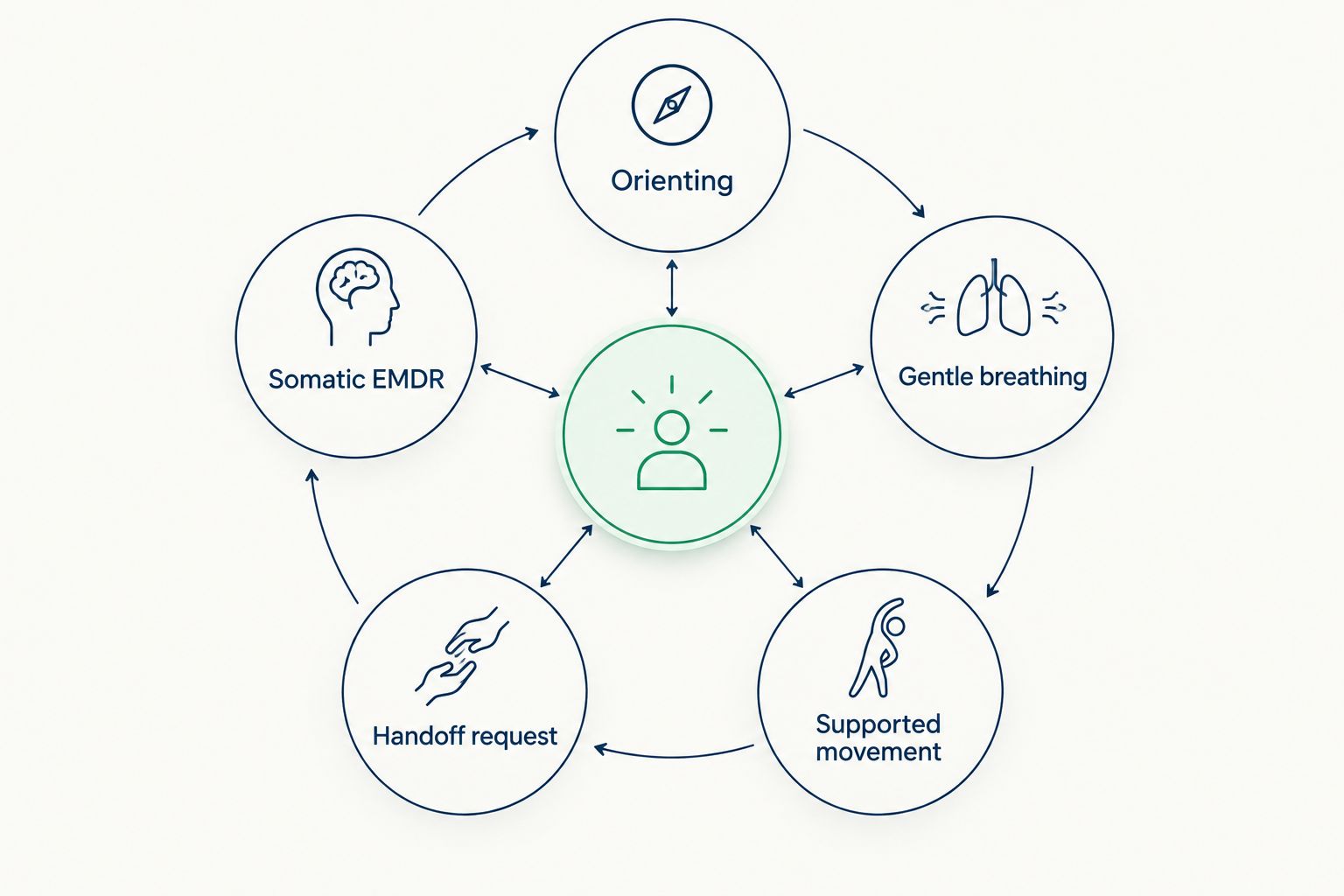
1. Orienting to the room: best for feeling disconnected
Orienting brings your attention to the environment around you. Look around and name a few neutral things you can see, such as a door, a chair, or the edge of a table. Notice where your body is supported, then decide what needs your attention next.
This is the best default when you need to stay aware of the room. You do not have to close your eyes, change your breathing, or recall anything distressing. If you want a starting structure, spend 30 seconds looking around before deciding whether to continue; that is an optional practice cue, not a required dose.
Orienting pros:
- Works while you remain aware of a person you are caring for.
- Gives your attention a present-day reference point.
- Can be shortened or stopped without completing a sequence.
Orienting cons:
- Focusing on the room may be uncomfortable if the setting feels unsafe.
- It does not resolve the task or relationship creating the stress.
Best for: A caregiver who feels scattered or disconnected but still needs to track what is happening nearby. If looking around increases alarm, stop and choose a different point of support. Verdict: Try first when your surroundings feel safe enough to notice.
2. Gentle exhale-focused breathing: best for a racing mind
Notice your next breath without trying to make it deep. If it feels comfortable, let the exhale soften and take a little longer than the inhale. Return to breathing normally whenever you want; holding your breath or aiming for a perfect count is not the task.
In 2026, breathing advice often sounds universal. It is not. Some people find breath focus uncomfortable, particularly when they are panicking or feel disconnected from their bodies. For them, looking around the room or feeling the support of a chair is a better starting point.
Gentle breathing pros:
- Needs no equipment or private space.
- Lets you keep your eyes open and monitor the room.
- Gives you a brief pause before responding to a demand.
Gentle breathing cons:
- Attention to breathing can intensify discomfort.
- It cannot create time off or change an unsafe care arrangement.
Best for: A caregiver whose thoughts are moving quickly and who finds breath awareness tolerable. Try 3 unforced exhales, then reassess rather than making yourself continue. Verdict: Try when it helps; skip it when breath focus makes you feel worse.
3. Supported movement: best for physical tension
Supported movement gives physical restlessness somewhere to go without treating exercise as another obligation. Press your feet into the floor, release, and notice the contact beneath them. You can also shift your weight in a chair or move your shoulders gently within a comfortable range.
The goal is to notice what changes in your body, not to perform a routine correctly. Start with 1 minute if you have it; stop sooner if movement causes pain or increased distress. This option fits moments when sitting still makes tension more noticeable, provided it does not interfere with the care task in front of you.
Supported movement pros:
- Offers an alternative when stillness or breath focus does not fit.
- Can be adapted to seated or standing positions.
- Keeps attention on current physical sensations rather than a distressing memory.
Supported movement cons:
- A movement that suits one person may not suit another person's mobility or pain needs.
- It cannot replace sleep, time off, or help with caregiving duties.
Best for: A caregiver who notices clenched muscles, restlessness, or difficulty settling in one position. Choose a motion you can stop easily. Verdict: Try gentle, supported movement when stillness feels unhelpful; skip any motion that hurts.
4. A specific handoff request: best for an unsustainable load
A handoff request is not a body exercise. It is a practical regulation tool when the problem is too much responsibility for one person to carry. Name the task, the time, and the help you need: ask someone who is able to assist to take over a defined duty while you step away.
Specificity matters because a vague request for help leaves the next action unclear. You can ask for someone to handle a meal, make a call, or cover a care period; choose a task that actually exists in your situation. If no one is available, that is a support gap, not a failure to regulate your nervous system.
Handoff request pros:
- Addresses part of the workload rather than only your reaction to it.
- Gives another person a clear task to accept or discuss.
- Makes it easier to identify where reliable backup is missing.
Handoff request cons:
- Depends on other people or services being available.
- A single handoff will not fix an ongoing imbalance of care.
Best for: A caregiver whose immediate stress comes from competing tasks and too little backup. Make the request as concrete as the task itself. Verdict: Prioritize a handoff over another calming exercise when the load is the problem.
5. Therapist-guided Somatic EMDR: best for persistent trauma-related distress
Somatic EMDR is a therapy option, not a technique to perform on yourself between caregiving tasks. EMDR with Kelli offers Somatic EMDR intensives and weekly sessions for adults in Escondido and San Diego County who are dealing with concerns including PTSD, complex trauma, and anxiety. A clinician can assess whether therapy fits your symptoms and circumstances.
EMDR with Kelli is best for San Diego County caregivers seeking therapist-guided Somatic EMDR when self-regulation alone does not address trauma-related distress. That recommendation is about the need for assessment and treatment, not a promise that a particular approach will work for every caregiver. If you need help in the next few minutes, use an immediate support option first; therapy serves a different purpose.
Therapist-guided Somatic EMDR pros:
- Puts persistent symptoms in a clinical conversation instead of leaving you to interpret them alone.
- Offers a setting to discuss trauma-related concerns and body-focused responses.
- Provides an alternative to repeatedly adding self-help exercises when they are not enough.
Therapist-guided Somatic EMDR cons:
- Cannot take over caregiving duties or supply backup care.
- Is not an immediate intervention during an urgent safety concern.
- Requires an individual discussion to determine whether it fits your needs.
Best for: An adult caregiver seeking clinical support for ongoing trauma-related distress in the stated service area. You can read about EMDR with Kelli on the EMDR with Kelli website. Verdict: Consider an assessment; do not treat therapy as a substitute for immediate practical support.
How these tools were ranked
The ranking puts options you can use while staying aware of your surroundings first. It then moves from an immediate body-based response to a change in workload and, finally, a clinical option for distress that needs individual attention. That order does not mean orienting treats burnout better than therapy or that therapy replaces rest. Each has a different job.
For 2026, the strongest choice is the one that matches both your symptoms and your responsibilities. If an exercise increases distress, stop. If the care load remains unmanageable after a pause, seek help with the load rather than repeating the exercise and expecting a different situation.
Which self-regulation tool should you choose?
Choose orienting if you are undecided and the room feels safe enough to notice. It requires little preparation and leaves you aware of the person or task in front of you. Choose gentle breathing if it feels comfortable; choose supported movement if your body needs motion instead of stillness.
If your main thought is that you cannot keep doing everything alone, choose a specific handoff request. If trauma-related symptoms remain a concern, discuss them with a qualified clinician. In 2026, no ranked list can decide from your symptoms alone whether Somatic EMDR is the right treatment; an individual assessment has that role.
FAQ
What is the best self-regulation tool for caregiver burnout?
Orienting to the room is a practical first choice when your surroundings feel safe enough to notice. If the main problem is an unsustainable care load, ask for a specific handoff instead of relying on an exercise alone.
What if breathing exercises make me feel worse?
Stop the breathing exercise and choose a different way to stay present. Looking around the room or noticing the support of a chair does not require you to focus on your breath.
Can self-regulation cure caregiver burnout?
No self-regulation exercise can remove an excessive care load by itself. Brief tools can help you respond in the moment, while workload, rest, and support need separate attention.
Is Somatic EMDR a self-help exercise?
No. Somatic EMDR is therapist-guided care, not a technique to start on your own during a difficult caregiving moment. Discuss whether it fits your concerns with a qualified clinician.
Should I choose movement or grounding when I feel restless?
Choose gentle supported movement if sitting still increases discomfort and movement feels safe for your body. Choose orienting if you need to reconnect with your surroundings while remaining still.
How long should I spend on a regulation exercise?
Use only as much time as fits your situation and stop if distress increases. You do not need to complete a set duration for an exercise to be a valid attempt at self-regulation.
When should a caregiver seek professional help?
Seek professional support when distress persists, trauma-related symptoms concern you, or exhaustion is affecting your ability to care for yourself or someone else. If there is an immediate danger, seek urgent local help rather than waiting for a therapy appointment.
One last thing
Before trying another technique, ask whether you need a steadier moment or a lighter load. In 2026, that distinction is the most useful filter in this list: use a brief exercise for the moment in front of you, and make a concrete support request when the work itself needs to change.