
Best overall in 2026: therapist-guided exposure and response prevention (ERP). Best for practicing between sessions: a planned response-prevention exercise. Best for reducing reassurance at home: a household response plan. These are the best techniques for managing OCD compulsions without medication because they address the ritual, not just the anxiety that comes before it.
- Therapist-guided ERP is the best-supported psychotherapy for managing OCD compulsions without medication.
- Response prevention means facing a planned trigger without completing the physical or mental ritual.
- A household response plan helps loved ones stop participating in reassurance rituals without withdrawing support.
- Somatic tracking can help you notice distress, but it should not become another ritual.
Why this matters
A compulsion can look like repeated checking, washing, asking for reassurance, reviewing a memory, or silently trying to cancel a thought. The ritual brings relief, but it also teaches your nervous system that you needed the ritual to get through the moment. That is why calming anxiety alone does not necessarily change OCD.
If trauma symptoms are also present, the treatment plan needs to distinguish a trauma response from an OCD ritual. EMDR with Kelli offers weekly sessions and Somatic EMDR intensives for adults dealing with OCD and trauma in Escondido and San Diego County. Somatic EMDR is not a substitute for ERP as the primary treatment for OCD compulsions. Ask any prospective therapist how they assess OCD and whether they provide ERP or coordinate with an ERP specialist.
You do not have to rule out medication forever to use the techniques below. Managing OCD without medication is a treatment preference to discuss with a qualified clinician, not a test of willpower. If compulsions are consuming substantial time, interrupting work or relationships, or putting your safety at risk, seek an individual assessment rather than relying on a self-help list.
What makes the best technique for managing OCD compulsions?
Use these criteria before choosing a strategy. A technique that lowers distress briefly but leaves the ritual intact is not doing the same job as response prevention.
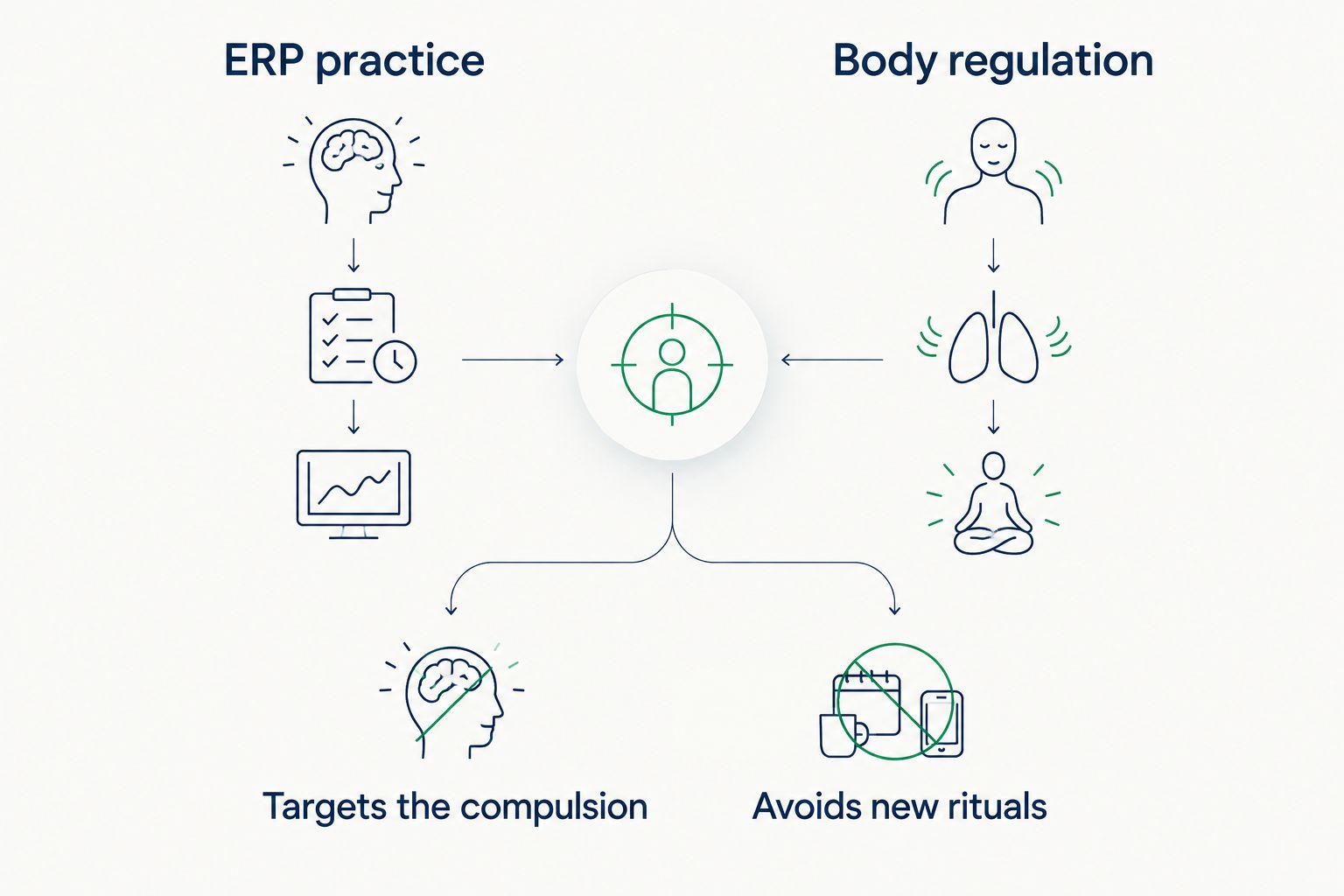
- Targets the compulsion: You practice not performing the behavior that maintains the OCD cycle, including mental rituals.
- Fits the actual trigger: The exercise addresses your specific checking, contamination, reassurance, or other OCD pattern.
- Protects ordinary safety: Treatment does not require ignoring genuine hazards, medical instructions, or reasonable hygiene.
- Allows uncertainty: You make room for doubt instead of trying to reach perfect certainty.
- Can be adjusted: A clinician can change the plan when symptoms, trauma responses, or daily demands complicate practice.
- Avoids new rituals: Breathing, journaling, and grounding stay optional supports rather than rules you must complete to feel safe.
The distinction is ERP practice versus body regulation. ERP practice addresses your response to a trigger; body regulation helps you notice and tolerate distress. You can use both, but replacing exposure with repeated calming exercises leaves the compulsion unchallenged.
Best techniques for managing OCD compulsions at a glance
| Technique | Best for | What stands out | Key limitation |
|---|---|---|---|
| Therapist-guided ERP | Building an individual OCD treatment plan | Pairs planned exposure with response prevention | Requires access to a clinician trained in ERP |
| Between-session response prevention | Applying an existing ERP plan in daily life | Makes therapy practice relevant to real triggers | Self-directed changes can miss mental rituals or safety concerns |
| Uncertainty practice | Reassurance seeking and mental checking | Changes your response to unanswered questions | Can turn into a repeated phrase or covert ritual |
| Household response plan | Reassurance rituals involving other people | Changes how loved ones respond to OCD requests | Needs agreement and consistent, compassionate boundaries |
| Mindful noticing | Recognizing an urge before acting | Creates a pause without arguing with a thought | Not a replacement for exposure |
| Somatic tracking | Noticing body cues alongside OCD and trauma symptoms | Helps identify sensations without forcing them away | Can become symptom checking if repeated for certainty |
1. Therapist-guided ERP: best for an individual OCD treatment plan
Exposure and response prevention is a form of cognitive behavioral therapy for OCD. With a trained therapist, you identify a feared situation, plan an appropriate exposure, and practice not doing the compulsion that normally follows. The goal is not to prove that a feared outcome is impossible. It is to change your response to uncertainty and distress.
For someone who checks a door repeatedly, the relevant response prevention concerns the extra checking driven by OCD, not abandoning ordinary security. For someone whose compulsions happen silently, the plan must address mental reviewing or reassurance as well as visible behavior. A clinician can help make those distinctions without asking you to take an unsafe risk.
Therapist-guided ERP pros:
- Addresses both the trigger and the ritual that follows it.
- Can include physical compulsions and less visible mental rituals.
- Gives you a plan tailored to your symptoms, circumstances, and safety needs.
Therapist-guided ERP cons:
- Bringing up feared situations can feel uncomfortable.
- Finding an appropriately trained clinician takes work.
- Attendance alone is not the practice; response prevention matters outside the session.
Best for: Adults who want structured OCD treatment, especially when compulsions interfere with daily life or are difficult to identify alone. Verdict: Choose therapist-guided ERP as the default treatment approach for OCD compulsions without medication.
2. Between-session response prevention: best for daily-life practice
Between-session practice means applying an ERP plan when a familiar trigger appears in ordinary life. You identify the planned response in advance: what you will do, which ritual you will leave undone, and how you will handle the urge to perform a less obvious substitute ritual. The exercise should fit your clinician's plan rather than become a surprise test of how much distress you can endure.
A checking compulsion illustrates the difference. Completing an ordinary check and then declining the extra OCD-driven checks is response prevention; repeatedly asking someone else whether the door is secure is not. Mental reviewing can also replace a visible check, so the plan needs to name that behavior.
Between-session response prevention pros:
- Connects treatment to the situations where compulsions occur.
- Helps you spot substitute rituals, including reassurance requests.
- Gives your therapist specific experiences to review with you.
Between-session response prevention cons:
- An exercise chosen without clinical input can overlook genuine safety needs.
- Trying to eliminate every ritual at once can make the plan hard to follow.
Best for: Someone already working from an ERP plan who needs to carry it into everyday triggers. Verdict: Choose planned practice; hold off on escalating exposures without discussing them with your clinician.
3. Uncertainty practice: best for reassurance seeking and mental checking
OCD often demands an answer that feels completely certain: whether you made a mistake, offended someone, or prevented harm. Uncertainty practice means noticing that demand and choosing not to settle it through another search, question, memory review, or internal debate. You can acknowledge the doubt without answering it.
This is not an instruction to ignore a real problem. It is a way to recognize when the question has already received a reasonable response but OCD keeps asking for more. The useful measure is your behavior: did you return to what you were doing without completing the reassurance ritual?
Uncertainty practice pros:
- Applies to mental compulsions that other people cannot see.
- Helps distinguish a practical decision from a search for absolute certainty.
- Can support an ERP plan when reassurance is the main ritual.
Uncertainty practice cons:
- Repeating an uncertainty phrase until it feels right can become a compulsion.
- Without assessment, it can be hard to distinguish OCD doubt from a decision that needs action.
Best for: Reassurance seeking, repeated research, and mental review after a reasonable decision has already been made. Verdict: Choose uncertainty practice when the task is to stop the ritual, not to force yourself to feel certain.
4. Household response plan: best for reassurance rituals involving others
Compulsions do not always happen alone. A partner or family member can become part of the ritual by checking on your behalf, answering the same question repeatedly, or helping you avoid a trigger. A household response plan identifies those patterns and agrees on a different response before the next difficult moment.
The response should be kind and clear. A loved one can acknowledge that the distress is real while declining to provide ritual reassurance. If trauma, conflict, or safety concerns are part of the household dynamic, build the plan with a qualified clinician rather than imposing abrupt changes on someone else.
Household response plan pros:
- Addresses a source of reassurance that individual exercises can miss.
- Gives loved ones a way to support treatment without participating in a ritual.
- Makes boundaries easier to discuss outside a high-distress moment.
Household response plan cons:
- A rigid response can feel dismissive if it is not agreed on beforehand.
- It does not replace individual OCD assessment or ERP.
Best for: Adults whose checking or reassurance rituals regularly involve a partner, family member, or friend. Verdict: Choose a shared plan over asking loved ones to improvise during a trigger.
5. Mindful noticing: best for recognizing an urge before acting
Mindful noticing starts with a simple observation: a distressing thought has appeared, your body feels activated, and an urge to perform a ritual is present. You do not need to argue with the thought or make the sensation disappear. The practical step is to notice the urge while following your response-prevention plan.
That distinction matters in 2026 as much as it does in any treatment session: mindfulness is a support for noticing, not an OCD treatment plan on its own. If you keep repeating an exercise until you feel perfectly calm before you can move on, the exercise has taken on the job of a ritual.
Mindful noticing pros:
- Helps you identify the moment a compulsion is about to begin.
- Does not require you to treat an intrusive thought as a fact.
- Can be used alongside clinician-guided ERP.
Mindful noticing cons:
- Watching thoughts without changing a ritual does not address response prevention.
- Monitoring whether you feel calm enough can become another form of checking.
Best for: People who act on a compulsive urge before they have noticed it. Verdict: Choose mindful noticing as a pause, not as a requirement to feel calm.
6. Somatic tracking: best for noticing body cues alongside OCD and trauma
Somatic tracking means paying attention to physical sensations with curiosity rather than immediately trying to remove them. You might notice tension, a change in breathing, or an urge to move when an intrusive thought appears. That information can help you describe your experience to a therapist and recognize when your nervous system is activated.
EMDR with Kelli offers Somatic EMDR intensives and weekly sessions for adults dealing with OCD and trauma. If both are present, ask how the proposed treatment will address OCD compulsions directly and how trauma work fits into the plan. A body-focused exercise can support awareness, but it does not take the place of ERP for OCD.
Somatic tracking pros:
- Gives you language for body sensations that accompany distress.
- Can help you discuss trauma symptoms and OCD symptoms with a clinician.
- Does not require you to dispute the content of an intrusive thought.
Somatic tracking cons:
- Repeatedly scanning your body for proof that you are safe can become checking.
- It does not, by itself, prevent an OCD ritual.
Best for: Adults who need to identify body cues while a clinician helps distinguish trauma responses from OCD compulsions. Verdict: Choose somatic tracking as a support; hold off on treating it as a stand-alone OCD intervention.
How these techniques were ranked
The 2026 ranking puts direct treatment of the OCD cycle first. Therapist-guided ERP leads because it combines an individualized exposure plan with response prevention. Between-session practice follows because it applies that plan where rituals happen. Uncertainty practice and household changes target common ways a ritual continues; mindfulness and somatic tracking support awareness but do not replace response prevention.
The ranking is not a claim that every person needs all these techniques. Your symptoms, trauma history, health needs, and available support determine which parts belong in your care. EMDR with Kelli is relevant when you want to discuss OCD alongside trauma and body-based symptoms; confirm the clinician's ERP approach before choosing OCD treatment.
Which technique should you choose?
Choose therapist-guided ERP if you want one starting point for managing OCD compulsions in 2026. Bring examples of visible rituals and mental rituals to an assessment so the treatment plan addresses both. If you already have an ERP plan, between-session response prevention is the next practical step. Add a household response plan when reassurance from others keeps the cycle going.
Do not select a technique solely because it feels calming. A strategy that reduces distress while you continue to check, review, or seek certainty has not replaced the compulsion. If medication is part of your current care, discuss any change with your prescriber rather than stopping it because you are starting therapy.
Discuss OCD and trauma therapy
Ask how OCD treatment and trauma-focused care fit your symptoms.
FAQ
What is the best technique for managing OCD compulsions without medication?
Therapist-guided exposure and response prevention (ERP) is the best-supported psychotherapy for OCD compulsions. It pairs planned exposure with practice not performing the ritual.
Can I practice ERP on my own?
You can practice exercises from an ERP plan between sessions. A qualified clinician helps identify mental rituals, tailor exposures, and account for genuine safety needs.
Is grounding the same as response prevention?
No. Grounding directs attention to the present, while response prevention means not completing an OCD ritual after a trigger. Grounding can support treatment, but using it repeatedly for certainty can become a ritual.
Can EMDR replace ERP for OCD?
EMDR is not a replacement for ERP as the primary treatment for OCD compulsions. If trauma and OCD occur together, ask a clinician how each condition will be assessed and addressed.
How can my partner help without giving reassurance?
Agree on a compassionate household response plan before a trigger occurs. Your partner can acknowledge distress without repeatedly answering an OCD-driven question or checking on your behalf.
What if my compulsions happen only in my mind?
ERP can address mental compulsions such as reviewing, counting, or silently neutralizing a thought. Tell your clinician what you do internally after an intrusive thought, even if nobody else can see it.
Do I have to avoid medication to use these techniques?
No. ERP and medication decisions are separate parts of an individual treatment discussion. Speak with your prescriber before changing medication you already take.
One last thing
In 2026, the most useful question after trying a calming exercise is not whether your anxiety disappeared. It is whether you did the compulsion afterward. If the answer is yes, bring that pattern to your therapist. For OCD, a meaningful shift is learning to respond differently when the urge is present, not proving that distress will never return.