Best overall: seated mountain. Best for rest with an easy exit: constructive rest. Best for people who prefer to stay standing: wall-supported standing. The best trauma-informed yoga poses in 2026 are the ones you can adjust, leave, or decline without treating discomfort as a test to pass.
- Seated mountain is the best trauma-informed yoga pose to start with because you can change position or stop at any time.
- Constructive rest suits people who want to lie down; wall-supported standing suits people who prefer to remain upright.
- You do not need to close your eyes, control your breath, or stay in a pose that feels unsettling.
- Yoga can support body awareness, but it does not replace trauma treatment such as Somatic EMDR.
Why this matters
Trauma can affect how safe it feels to notice your body. A quiet room, a closed-eye instruction, or a position that makes it hard to see the door can feel settling to one person and unsettling to another. The pose is not the measure of success; your ability to choose what happens next matters more.
In 2026, trauma-informed yoga is best understood as an approach to offering movement, not a fixed set of poses with predictable effects. You can keep your eyes open, look around the room, use support, or stop. If body-focused exercises bring up distress, you do not need to push through it to benefit.
For adults seeking trauma treatment rather than a yoga routine, EMDR with Kelli offers Somatic EMDR intensives and weekly sessions in Escondido and San Diego County. Trauma-informed yoga poses can be an optional practice alongside care; they are not a substitute for EMDR or another appropriate treatment.
What makes the best trauma-informed yoga poses?
These criteria explain the ranking. They focus on choice and practical access, not on a claim that one posture heals the nervous system better than another.
- Clear exit: You can leave the position without having to finish a sequence.
- Optional support: A chair, wall, or floor can carry some of the work if you want it to.
- Choice of attention: You can notice the room instead of focusing on sensations inside your body.
- Easy adjustment: You can change your gaze, position, or amount of movement without losing the point of the exercise.
- No required breath pattern: You can let breathing happen naturally rather than trying to make it slow or deep.
A pose that meets these criteria can still feel wrong for you. Treat discomfort as information, not an instruction to stay longer. In 2026, the most useful ranking is one that helps you select a position you can actually leave or adapt.
Best trauma-informed yoga poses at a glance
| Pose | Best for | Standout feature | Key limitation |
|---|---|---|---|
| Seated mountain | Starting with a chair | Easy to adjust or leave | Sitting can feel confining |
| Constructive rest | Resting on the floor | Supports the back while knees bend | Lying down can feel too exposed |
| Wall-supported standing | Remaining upright | Lets you use the wall for support | Standing can become tiring |
| Tabletop | Exploring gentle movement | Makes small changes of position possible | Weight on wrists or knees can hurt |
| Supported child's pose | Trying a folded shape | Allows support beneath the body | The position can restrict your view |
Best for does not mean safe or comfortable for everyone. If a pose aggravates pain, dizziness, panic, or a sense of being trapped, change it or stop. You can choose a different position without completing the list.
1. Seated mountain: best trauma-informed yoga pose for starting with a chair
Sit on a stable chair in a position you choose. Your feet can meet the floor if that is comfortable, and your hands can rest wherever they feel at ease. Look around the room or toward a fixed point; you do not need to sit perfectly upright or close your eyes.
Seated mountain ranks first because it asks for little setup and leaves your options visible. You can shift, stand, or move to a different seat. If you want to notice body sensations, start with a neutral point of contact, such as the chair beneath you, and return your attention to the room whenever you prefer.
Seated mountain pros:
- Works with an ordinary stable chair.
- Allows an open-eyed view of your surroundings.
- Gives you a straightforward way to change position.
Seated mountain cons:
- Sitting still can feel confining, even in an open room.
- A chair that does not support your body comfortably can distract from the exercise.
Best for: Someone who wants a low-demand starting point and prefers not to get on the floor. Verdict: Try seated mountain first if sitting feels accessible; skip it if staying seated increases distress.
2. Constructive rest: best trauma-informed yoga pose for supported rest
Lie on your back with your knees bent and your feet resting on the floor, if that position is comfortable. You can support your head with a cushion or choose another resting position. Keep your eyes open if you want to track the room.
Constructive rest gives you the option to stop holding yourself upright. That does not make lying down calming for everyone. Before settling in, notice whether you can get up easily and whether the place you chose feels comfortable enough to remain there by choice.
Constructive rest pros:
- Does not require a stretch or a controlled breathing exercise.
- Lets you notice support from the floor without changing position.
- Can be adjusted with a cushion or a different leg position.
Constructive rest cons:
- Lying on your back can feel exposed.
- Getting down to and up from the floor is not accessible for everyone.
- The position can be uncomfortable for some backs or hips.
Best for: Someone who wants to rest and feels comfortable getting onto the floor. Verdict: Try constructive rest only if lying down feels like a choice, not an obligation.
3. Wall-supported standing: best trauma-informed yoga pose for staying upright
Stand near a wall and use it for support in whatever way feels comfortable. Keep your gaze where you want it, and let your stance change if you need more room. You can step away or sit down without completing a hold.
Wall-supported standing suits people who prefer to remain upright and aware of their surroundings. The wall is an option, not a posture target: you do not have to press into it or hold a particular alignment. Notice whether support makes standing easier, then decide whether to continue.
Wall-supported standing pros:
- Keeps you upright and able to see the room.
- Offers support without requiring floor work.
- Makes it simple to step away or change stance.
Wall-supported standing cons:
- Standing can be tiring or uncomfortable.
- A wall does not remove the risk of losing balance.
Best for: Someone who wants movement without sitting or lying down. Verdict: Try wall-supported standing if standing is comfortable; skip it when balance or fatigue is a concern.
4. Tabletop: best trauma-informed yoga pose for exploring small movements
On a comfortable surface, place your hands and knees down if that position suits your joints. From there, you can remain still or make a small movement of your back or hips. There is no need to match movement to breath or reach a particular shape.
Tabletop gives you room to experiment with movement rather than hold a pose. It ranks below the seated and standing options because it puts weight on your hands and knees and makes leaving the position less immediate. If you want a similar sense of choice without floor work, move your shoulders or back while seated instead.
Tabletop pros:
- Allows movement without a fixed sequence.
- Makes it easy to reduce the size of a movement.
- Offers a way to notice how a position feels before changing it.
Tabletop cons:
- Weight on wrists or knees can cause pain.
- Being on the floor can feel vulnerable or be difficult to access.
Best for: Someone comfortable on hands and knees who wants to explore small movements. Verdict: Hold on tabletop if floor access or joint comfort is uncertain; choose a seated alternative.
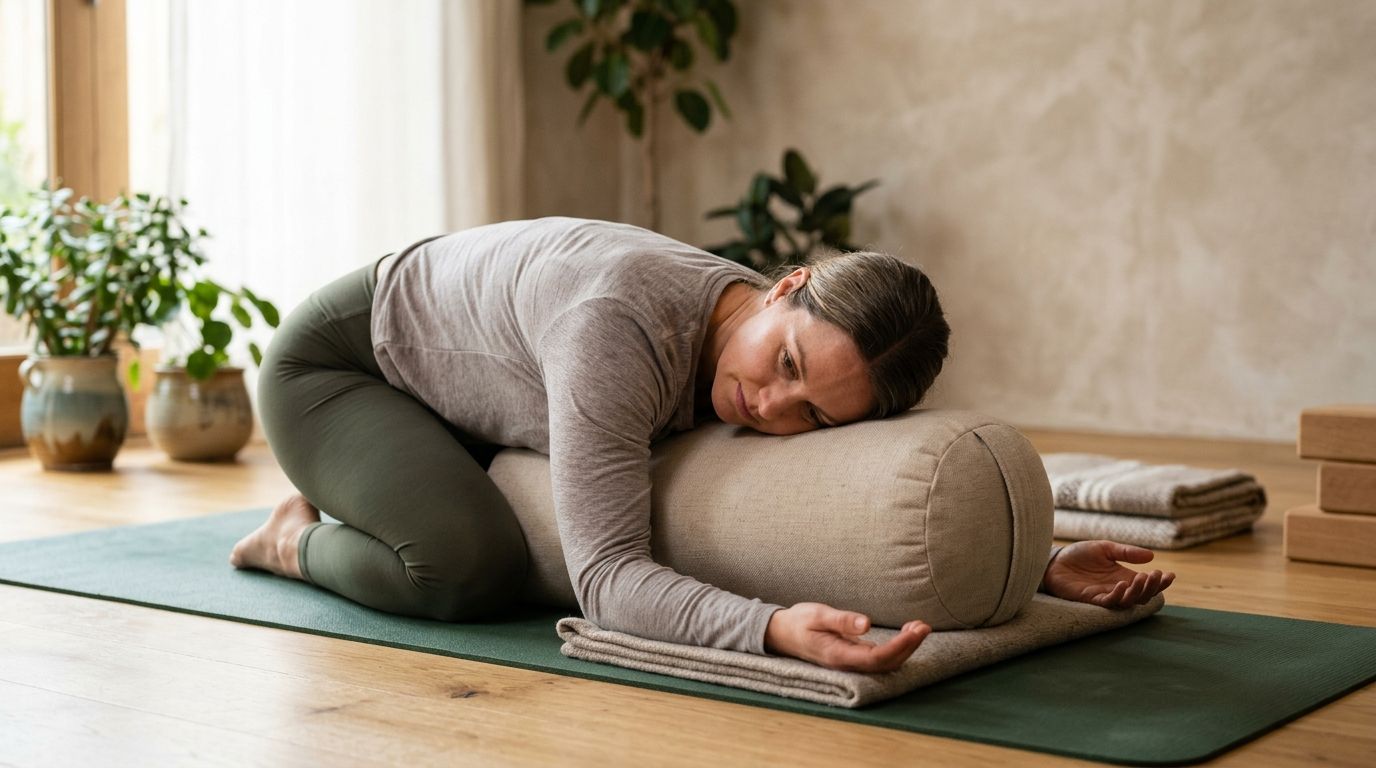
5. Supported child's pose: best trauma-informed yoga pose for trying a folded shape
From a kneeling position, fold forward only as far as feels comfortable, using cushions for support if you choose. Your head does not have to touch the floor. You can keep your face turned so you can see the room, or leave the pose altogether.
Supported child's pose belongs last because folding forward can limit your view and make some people feel enclosed. It also asks more of the knees, hips, and back than the first three choices. Support changes the shape of the pose; it does not create a reason to stay when the position feels wrong.
Supported child's pose pros:
- Can be adjusted with cushions.
- Does not require stillness or closed eyes.
- Offers an option for people who prefer a folded position.
Supported child's pose cons:
- Can feel enclosed or limit your view of the room.
- May aggravate knee, hip, or back discomfort.
- Getting into and out of it can be difficult.
Best for: Someone who already knows that a supported folded position feels comfortable. Verdict: Wait on supported child's pose if you are unsure; seated mountain is the simpler starting point.
How these poses were ranked
The 2026 ranking prioritizes an easy exit, optional support, and freedom to direct your attention. It is a practical decision guide, not a clinical comparison showing that one pose treats PTSD, complex trauma, anxiety, or OCD better than another.
The order also reflects how much setup or physical access each pose asks of you. A chair-based position comes first; poses that require floor access, joint loading, or a reduced view of the room come later. Your own response can reverse that order. If standing feels better than sitting, start with wall-supported standing.
Which trauma-informed yoga pose should you choose?
Choose seated mountain if you are undecided in 2026. It offers a clear place to start without asking you to lie down, bear weight on your hands, or fold forward. If a chair feels restrictive, wall-supported standing is the next option to consider.
You do not have to use all five poses or turn them into a routine. Pick a position, notice whether you want to stay or change it, and let that decision guide what happens next. Stop if symptoms intensify. If you are managing trauma symptoms that disrupt daily life, discuss body-based practices with a qualified mental health professional rather than treating yoga as a replacement for care.
EMDR with Kelli offers Somatic EMDR for adults dealing with PTSD, complex trauma, anxiety, OCD, and relationship issues. That is a different service from yoga instruction. If trauma-informed yoga poses bring up material that feels difficult to process alone, professional support is the more relevant next step.
FAQ
What are the best trauma-informed yoga poses for beginners?
Seated mountain is the simplest starting choice because you can adjust or leave it easily. Wall-supported standing is an alternative if you prefer to stay upright rather than sit.
Do I have to close my eyes during trauma-informed yoga?
No, you do not have to close your eyes. Looking around the room or keeping a steady gaze is a valid choice during any pose.
Is child's pose always calming for trauma survivors?
No, supported child's pose is not calming for everyone. Folding forward can restrict your view or feel enclosing, so choose another position if it feels uncomfortable.
Can yoga heal PTSD or complex trauma?
Yoga does not replace treatment for PTSD or complex trauma. It can be an optional body-based practice, while a qualified clinician can help you assess treatment needs.
What if focusing on my breath makes me anxious?
You do not need to focus on or control your breath during these poses. Direct your attention to the room, the support beneath you, or another neutral point instead.
Should I push through discomfort in a trauma-informed yoga pose?
No, you can change or leave a pose when it feels distressing or painful. Choice and an easy exit matter more than holding a shape.
Is trauma-informed yoga the same as Somatic EMDR?
No, trauma-informed yoga and Somatic EMDR are different practices. EMDR with Kelli offers Somatic EMDR intensives and weekly therapy sessions; the yoga poses here are optional self-directed movements.
One last thing
In 2026, the most useful adjustment might be not doing the pose. If noticing the room while standing or sitting feels more manageable than following a yoga instruction, you can choose that instead. Trauma-informed practice leaves room for a meaningful no.