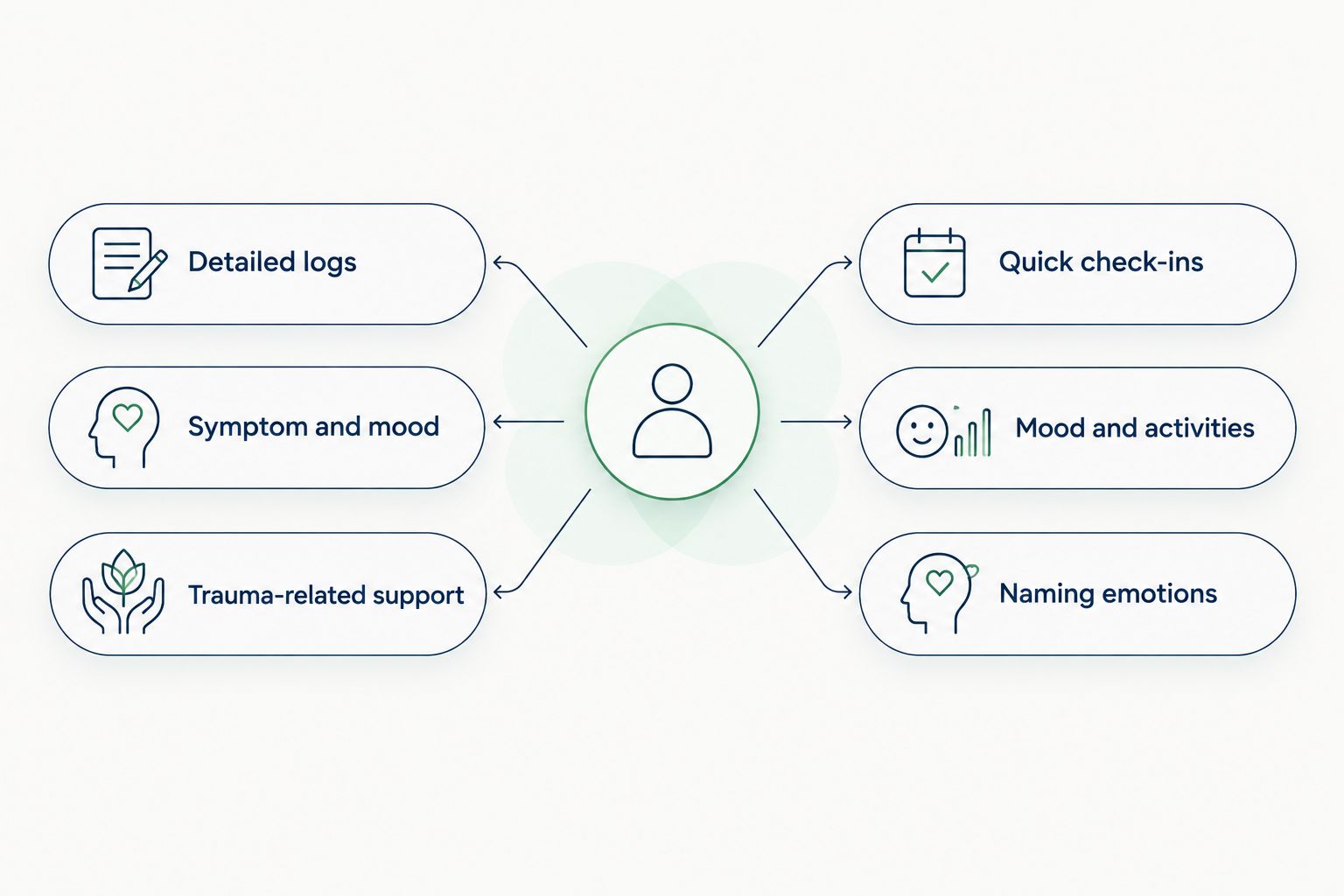
Best overall: Bearable for detailed anxiety symptom logs. Best for quick daily check-ins: Daylio. Best for trauma-related symptoms: PTSD Coach. Best built-in option for Apple users: Apple Health’s State of Mind. This 2026 guide compares what each app helps you record, where it falls short, and when tracking should lead to a conversation with a therapist.
- Bearable is the best app for tracking anxiety symptoms when you want to record mood and physical symptoms together.
- Daylio suits brief mood and activity check-ins; PTSD Coach suits people monitoring trauma-related symptoms.
- Apple Health’s State of Mind is a simpler choice for Apple users who want to name emotions.
- An app can organize observations, but it cannot diagnose anxiety or replace treatment.
Why this matters
Anxiety does not always announce itself as worry. You might notice a tight chest, disrupted sleep, a shift in attention, or an urge to avoid a particular situation. A useful tracker helps you describe what happened without asking you to spend the rest of the day analyzing it.
EMDR with Kelli is best for adults seeking somatic EMDR therapy, not another anxiety-tracking app. The practice offers intensives and weekly sessions for adults dealing with anxiety, PTSD, complex trauma, OCD, and relationship issues in Escondido and San Diego County. If your notes point to symptoms that interfere with daily life, EMDR with Kelli is a place to explore therapy rather than add more entries to an app.
The best apps for tracking anxiety symptoms in 2026 serve different purposes. One helps you capture body sensations; another makes it easier to notice what you were doing when your mood changed. Neither can tell you why a symptom occurred. Treat a pattern as a question to bring to a qualified clinician, not as a diagnosis.
What makes the best anxiety symptom tracker?
Use these criteria before choosing an app. A long feature list matters less than whether you can record the information you actually want to discuss.
- Relevant entries: Can you record anxiety, mood, physical sensations, or activities without forcing everything into a single score?
- Manageable effort: Will you complete an entry on a difficult day, or does the process itself add stress?
- Useful context: Can you distinguish a symptom from what happened around it without assuming one caused the other?
- Reviewable notes: Can you look back at entries and describe a pattern in ordinary language?
- Privacy decisions: Do you understand what you are entering, how the app handles it, and whether you want to share it?
- Fit for your concern: Are you tracking general anxiety, trauma-related symptoms, or emotional changes? These are not interchangeable questions.
Before entering sensitive details in any app, read its current privacy information and settings. You can often write less and still bring a useful observation to therapy: what you noticed in your body, what was happening, and what support you needed.
Anxiety tracking apps at a glance
| App | Best for | Standout feature | Key limitation |
|---|---|---|---|
| Bearable | Detailed symptom and mood logs | Records symptoms alongside mood | Detailed tracking can become too demanding |
| Daylio | Quick daily check-ins | Connects mood entries with activities | A mood entry alone can miss physical symptoms |
| PTSD Coach | Trauma-related symptom support | Combines symptom assessment with coping tools | Its PTSD focus is narrower than general anxiety tracking |
| Apple Health State of Mind | Apple users naming emotions | Logs momentary emotions and daily mood | Less suited to detailed physical symptom notes |
The table is a decision aid, not a clinical ranking. Choose the app that captures a useful observation with the least strain. In 2026, no entry format can establish that a particular event caused your anxiety; it records your account of what happened.
1. Bearable: best anxiety symptom tracker for detailed logs
Bearable lets you record symptoms and mood in one place. That makes it the strongest default here if anxiety shows up in your body as well as your thoughts. You can use an entry to note the sensation you noticed, how you described your mood, and what you want to ask about later.
The advantage is specificity; the risk is over-monitoring. If logging every sensation makes you check your body more often, reduce the detail or pause. An entry is useful when it helps you communicate, not when it becomes another task you feel compelled to complete.
Bearable pros:
- Captures physical symptoms as well as mood.
- Gives you a way to review observations rather than rely on memory alone.
- Suits a short, repeatable record of bodily anxiety symptoms.
Bearable cons:
- More detail takes more effort than a simple mood check-in.
- Symptom records cannot identify the medical or psychological cause of a sensation.
Best for: Adults who want to bring specific body-and-mood observations to a clinical conversation. Verdict: Buy only if detailed logging helps you notice patterns without increasing distress.
2. Daylio: best anxiety tracking app for quick check-ins
Daylio centers on mood and activities. Choose it when you want a brief account of how the day felt and what you were doing, rather than a detailed inventory of symptoms. A short entry is easier to revisit than an elaborate log you abandon.
Look for recurring circumstances, then describe them carefully. If several anxious entries followed work meetings, that is an observation about timing—not proof that meetings caused every symptom. The distinction matters when you discuss anxiety with a clinician.
Daylio pros:
- Keeps the focus on mood and daily activities.
- Gives you a straightforward way to compare entries over time.
- Fits a routine built around brief check-ins.
Daylio cons:
- A broad mood label can flatten distinct experiences into the same entry.
- It is not the first pick when physical symptoms are the main thing you need to describe.
Best for: People who want a short mood-and-activity record they can maintain. Verdict: Buy if a brief daily check-in is more useful to you than symptom-level detail.
3. PTSD Coach: best for trauma-related symptom support
PTSD Coach is a U.S. Department of Veterans Affairs app with PTSD symptom assessment and coping tools. Its focus makes it a more relevant choice when you want to monitor trauma-related symptoms than when you simply want a general mood diary. The app is also available to people outside the veteran community.
A self-assessment can help you name concerns, but it is not a diagnosis. If completing an assessment leaves you distressed, stop and seek support from a qualified professional rather than repeating it to look for a reassuring result. Tracking should give you information you can use, not keep you inside a symptom-checking loop.
PTSD Coach pros:
- Has a clear focus on trauma-related symptoms.
- Pairs symptom assessment with coping resources.
- Comes from the U.S. Department of Veterans Affairs.
PTSD Coach cons:
- Its PTSD focus is a poor match for someone seeking only a general anxiety diary.
- A self-assessment cannot replace an evaluation by a clinician.
Best for: Adults who want a trauma-focused symptom tool to discuss alongside professional support. Verdict: Buy for its specific focus; skip it if you need a broad daily anxiety log instead.
4. Apple Health State of Mind: best built-in emotional check-in
Apple Health’s State of Mind lets Apple users log momentary emotions and daily mood. It is the simplest pick on this list when your goal is to pause, name what you feel, and leave a record you can revisit. That narrower purpose is also its main limitation.
Naming an emotion can be useful without treating it as the whole story. If your concern is a racing heart, muscle tension, or another physical sensation, write down that detail separately rather than assuming a mood label captures it. If a physical symptom is new, severe, or concerning, seek medical advice rather than interpreting an app entry.
Apple Health State of Mind pros:
- Offers a direct way to record emotions and daily mood.
- Suits people who prefer a narrow check-in over a detailed symptom log.
- Fits a routine centered on identifying feelings.
Apple Health State of Mind cons:
- It is an Apple option, not a cross-platform recommendation.
- Emotion labels alone do not give a clinician a full account of physical symptoms or context.
Best for: Apple users who want to name and revisit emotional states. Verdict: Buy for a simple check-in; hold if you need detailed symptom tracking.
How we ranked the apps
Bearable leads because this question asks about anxiety symptoms, including sensations that a mood-only entry can miss. Daylio comes next for readers who will benefit more from a short, sustainable routine. PTSD Coach ranks as a focused alternative for trauma-related concerns, while Apple Health State of Mind suits a narrower emotional check-in.
These are recommendations by use case, not claims that one app treats anxiety better than another. The 2026 ranking puts the purpose of each entry, the effort required, and the limits of self-assessment ahead of feature count. It does not rate clinical outcomes or privacy protections.
Which anxiety tracking app should you choose?
Choose Bearable if you need one place to describe both anxiety and physical sensations. Choose Daylio if a brief mood-and-activity entry is the record you will actually keep. Choose PTSD Coach when trauma-related symptoms are the central concern, or Apple Health State of Mind when naming emotions is enough for your purpose.
Try a 2-minute check-in rather than documenting your entire day. Write down the situation, what you noticed in your body, and the word you would use for the feeling. Review your notes after 7 days and ask a practical question: Did these entries help me explain what I am experiencing? Those time periods are a suggested routine, not a clinical threshold.
If you find yourself checking repeatedly for certainty, make the routine smaller or stop. This matters particularly when intrusive thoughts or compulsive checking are part of the problem. A symptom tracker should not become a test you must pass before you can continue your day.
For adults working on trauma, an app can support a conversation about nervous-system responses, but it cannot guide trauma processing on its own. EMDR with Kelli offers somatic EMDR intensives and weekly sessions; a short record of your observations can help you explain what you want to address. You do not need a perfect timeline or a complete account of difficult events to ask for help.
What to bring to a therapy session
Bring observations rather than conclusions. A note such as my shoulders tightened during that conversation, and I had trouble settling afterward describes an experience. A note that declares the conversation the cause of every symptom closes the question before you and your therapist have explored it.
You can keep your summary to 3 points: a situation you remember, a body sensation or emotion you noticed, and what happened next. You do not have to hand over your phone or share an entire history. Decide what feels relevant, review the app’s sharing options, and discuss the parts you want to discuss.
In 2026, the most useful tracker is still the one that helps you communicate without making you monitor yourself more intensely. EMDR with Kelli’s therapy practice focuses on adults dealing with anxiety and trauma, including how distress is experienced in the body. An app can help you name that experience; treatment is a separate decision made with a qualified professional.
FAQ
What is the best app for tracking anxiety symptoms in 2026?
Bearable is the best overall pick in this guide for recording anxiety alongside physical symptoms and mood. Daylio is a better fit if you need a shorter mood-and-activity check-in.
Is Daylio better than Bearable for anxiety?
Daylio is better for brief mood and activity entries; Bearable is better for detailed symptom notes. Choose based on what you want to discuss later, not the number of fields available.
Can an anxiety tracking app diagnose an anxiety disorder?
No. An app records what you report and cannot replace an assessment by a qualified clinician.
Is PTSD Coach only for veterans?
No. PTSD Coach is a U.S. Department of Veterans Affairs app that people outside the veteran community can use for trauma-related symptom support.
How often should I track anxiety symptoms?
Use a schedule that gives you useful notes without increasing distress. A brief check-in is enough if repeated logging makes you focus more intensely on symptoms.
Should I share my anxiety app data with my therapist?
Share the observations you want to discuss, not necessarily your entire app history. A short summary of situations, sensations, and questions gives you a starting point.
Can tracking anxiety make symptoms feel worse?
Repeated checking can become distressing for some people. If logging increases your urge to monitor symptoms or seek reassurance, reduce it or discuss that pattern with a clinician.
One last thing
The most informative entry is not always the most detailed one. If you can describe when anxiety appeared, what you felt in your body, and what you needed next, you have a starting point for a conversation—not a verdict about yourself. Use the app to notice; let a qualified clinician help you interpret what those observations mean.